


Crypto debit cards are no longer just a way to convert Bitcoin into cash for everyday purchases. In 2026, there are plenty of options, from exchange-linked cards and stablecoin payment solutions to self-custody cards connected directly to crypto wallets.
But choosing one isn’t just about cashback. Availability depends on your country, better rewards may require staking or a paid subscription, and fees can quickly eat into your benefits. It’s also worth checking how each card works, as some are prepaid debit cards while others offer credit backed by crypto holdings.
We’ve selected 12 crypto cards worth considering in 2026, comparing their features, fees, rewards, and availability to help you find the right option, whether you prioritize low fees, stablecoin spending, cashback, or control over your assets.
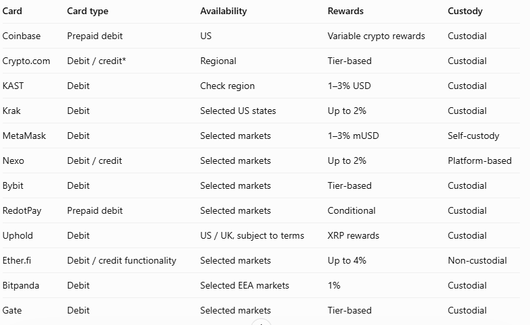
12 Crypto Debit Cards Compared
1. Coinbase Card
The Coinbase Card Visa prepaid debit card that lets US customers (excluding Hawaii) spend directly from their Coinbase accounts.
It is a custodial card, meaning funds remain in your Coinbase account and are deducted when you make a purchase. Coinbase automatically converts crypto to USD at checkout or for ATM withdrawals, so merchants never receive crypto. You also get a virtual card as soon as you’re approved, with Apple Pay and Google Pay support.
Fees are relatively low. There are no annual fees or charges for spending USD or crypto, including USDC. Coinbase Card does not charge monthly or foreign transaction fees, and there are no Coinbase ATM withdrawal fees (though ATM operators may charge their own). The main cost is Coinbase’s crypto conversion spread. Spending USD or USDC avoids it, making them the cheapest funding options.
Crypto rewards are the main attraction, but rates vary. Rewards are optional, available to US users, and paid in a crypto asset of your choice from a rotating list. Rates are displayed in the app, can be changed at any time, and have no stated cap. Although many reviews advertise rates of up to 4%, Coinbase does not guarantee a fixed rate on its official card page. Check the current in-app offer before applying.
Pros:
- No annual or spending fees
- Rewards without buying crypto first
- Strong security features such as two-factor authentication
- Card freezing and PIN changes
- Simple setup for existing Coinbase users
Cons:
- US-only
- Rewards are variable and rotate
- Paying with Bitcoin or other crypto counts as a sale
- Taxed on any gain since purchase
Best for: US-based Coinbase users who want a simple, low-fee card and crypto rewards without a credit check.
2. Crypto.com Visa Debit Card
Crypto.com’s crypto debit card depends on your region. In the US, it is now a Visa Signature credit card issued by Comenity Capital Bank through Bread Financial. Cardholders can earn rewards in BTC or CRO, but approval requires a credit check. Applications are made through the Crypto.com app.
Rewards range from roughly 1.5% to 5–6%, depending on the tier. However, higher Level Up tiers require locking up or staking CRO. Those who don’t want to commit CRO can choose the entry tier.
Outside the US, the card remains a prepaid debit card. In the European Economic Area (EEA), the free tier offers no cashback, while the Plus plan (€4.99/month) starts at 2% cashback.
Pros:
- Among the richest rewards in the category
- Wide regional coverage
- Tiered perks such as subscription rebates
Cons:
- Top rewards depend on staking or subscriptions
- Rewards value fluctuates with token prices
Best for: Users who already hold CRO and want to maximize rewards.
3. KAST
KAST is a Visa debit card that that spends a USD balance funded with stablecoins. It offers three tiers: Standard (free, 1.5% cashback), Premium ($1000 a year, 2% cashback) and Private ($10,000 a year, 3%).
Cashback is paid in dollars, rather than tokens. Monthly cashback limits apply: $2,000 in spend for Standard, $10,000 for Premium and $40,000 for Private.
However, KAST fees can reduce the returns. Foreign exchange fees on KAS crypto debit card range from 0.5% to 1.75%, while a physical Standard card costs $40 to deliver.
KAST estimates Standard users may keep up to 1% cashback after FX fees. Premium and Private also include a Visa Infinite card and KAST Points on eligible spending.
Pros:
- free tier with USD cashback
- Instant virtual card
- Eide geographic reach
- Stablecoin-first design
Cons:
- Cashback caps
- FX fees
- Paid tiers are expensive relative to the extra rewards,
- Custodial
Best for: Fequent stablecoin spenders, especially those spending in USD.
4. Krak Card
Krak, Kraken’s money app, launched its Visa debit card in the US in August 2026. Available as a physical and virtual card, it lets users spend from 600+ fiat and crypto assets, with purchases converted to USD at checkout. The card is issued by Lead Bank and powered by Stripe Issuing.
Krak offers up to 2% cashback in USD or Bitcoin, paid after transactions settle, with no monthly or annual fees.
Rewards depend on users’ average asset balances across Krak, Kraken and Kraken Pro. The card is available in all US states except New York, Maine, Massachusetts and Indiana. Crypto-funded purchases may incur conversion spreads and trigger taxable events.
Pros:
- Huge asset support
- Cashback in USD or BTC
- No monthly or annual fees
- Backed by an established exchange
Cons:
- Newly launched in the US
- Top cashback depends on balances held
- Some states excluded
Best for: US users who hold a mix of crypto and cash and want one card for everything.
5. MetaMask Card
The MetaMask Card lets users spend directly from their self-custody wallet, without preloading funds. Built with Mastercard and Baanx (now Monavate) and issued by Cross River Bank in the US, it works wherever Mastercard is accepted, including online, in-store and through Apple Pay or Google Pay. Unlike exchange cards, MetaMask Card allows to retain full control of your crypto until purchase.
The card has two tiers: the standard card offers 1% cashback in mUSD, while the Metal card costs $199/year and offers 3% cashback on up to $10,000 in annual spending, no foreign transaction fees and higher limits.
Outside the US, it is available in Argentina, Brazil, Canada, Colombia, the EEA, Mexico, Switzerland and the UK. The trade-off is that users take full responsibility for securing their own assets.
Pros:
- Self-custody
- mUSD cashback
- Apple Pay/Google Pay
Cons:
- Low base cashback
- The better rewards cost $199 a year
Best for: Existing MetaMask users who want to keep control of their keys.
6. Nexo Card
The Nexo Card is a Mastercard issued by DiPocket UAB, a Lithuanian-licensed e-money institution (EMI). It offers two app-controlled modes: Credit Mode, which lets users borrow against their crypto without selling it, and Debit Mode.
Cashback depends on Nexo’s loyalty tier, portfolio balance, and card mode. Rewards are paid in NEXO tokens or BTC, with payouts changeable at any time. Rates can reach 2% in NEXO or 0.5% in BTC, although Nexo’s regional page lists up to 2% cashback for credit card holders.
The card is available to eligible users in selected European markets, including the EEA and UK.
Pros:
- Debit and credit modes
- No annual fee
- Interest earning on balances
- Spend without selling
Cons:
- Best rates tied to holding NEXO tokens
- Not available to US residents
- Borrowing costs in Credit Mode.
Best for: European long-term holders who want liquidity without selling.
7. Bybit Card
The Bybit Card is a Mastercard debit card linked to your Bybit account. In the EEA and Switzerland, it is issued by Moorwand Ltd and Harmoniie SAS, with a 0.5% FX fee on top of Mastercard’s rate and a 0.9% crypto conversion fee.
Availability is limited to selected markets, including the EEA, Switzerland, Australia, Argentina, Brazil, parts of Asia Pacific, and Mexico.
Rewards depend on spending tiers or VIP status, not a flat cashback rate. The advertised “up to 10%” applies only to top tiers.
Fees and limits vary by region, and cashback without VIP status can be minimal, particularly outside Europe. US users should consider alternatives.
Pros:
- No annual fee
- Free virtual card
- Strong in Europe
- Tied to a major exchange
Cons:
- Not available in the US
- Rewards depend on VIP status
- Rules differ by region
Best for: Non-US Bybit traders who want to spend without leaving the crypto exchange.
8. RedotPay
RedotPay is a custodial Visa card for global stablecoin users, allowing crypto spending in over 100 countries.
It costs $10 for a virtual card or $100 for a physical one, with no monthly or annual fees, and supports major assets including USDT, USDC, BTC, ETH, BNB and SOL.
Standard pricing includes a 1% crypto-to-fiat conversion fee for USD transactions and an additional 1.2% FX markup.
Standard RedotPay accounts offer no ongoing cashback, relying on welcome bonuses and referral rewards. However, its optional RedotPay Pro membership offers 3% cashback on eligible Apple Pay and Google Pay purchases.
The card is unavailable in the US, Canada, China, Japan, South Korea, the Philippines and Russia.
Pros:
- broad coverage
- Low fixed costs
- High spending limits
- Multi-chain funding
Cons:
- Not available in the US,
- FX fees
- Custodial
Best for: Freelancers and remote workers paid in USDT outside the US.
9. Uphold Card
Uphold relaunched its US debit card in October 2025, advertising up to 6% in XRP rewards, with additional benefits for direct deposit users. Actual rates vary by tier and conditions, with some sources citing up to 4%. The US offers Essential and Elite plans, both paying rewards exclusively in XRP.
Essential has no annual fee but charges $4.99 for a physical card, $2.95 per ATM withdrawal, and $1.50 in foreign transaction fees.
Elite costs $99.99 annually, includes a metal card, and waives Uphold ATM and foreign transaction fees.
Crypto-funded spending may involve spreads and taxable events. Availability varies by state, while UK users receive a separate program offering 1% cashback in GBP.
Pros:
- Supports hundreds of assets
- No staking required
- Available in the US and UK
Cons:
- State restrictions
- Custodial
Best for: US users who want a multi-asset card and are comfortable earning XRP.
10. Ether.fi Cash
Ether.fi Cash is a non-custodial Visa card that connects DeFi assets to everyday spending. Users can pay directly with USDC or LiquidUSD, or borrow against their crypto without selling it.
The card combines debit-style direct payments with crypto-backed credit. Rewards reach 3% in USDC for most users and 4% for VIP members on the first $50,000.
It offers up to 3% cashback in USDC for most users, rising to 4% for VIP members on the first $50,000 spent. Fees and eligibility vary by tier and region, with some benefits requiring ETHFI staking.
Pros:
- Self-custody,
- USDC cashback
- Borrow-instead-of-sell option
- Broad geographic reach
Cons:
- DeFi complexity and liquidation risk when borrowing
- Tier and FX terms vary
- Not available everywhere
Best for: experienced DeFi users already inside the ether.fi ecosystem.
11. Bitpanda Card
The Bitpanda Card is a simple Visa debit card for EEA residents. It is available in all Eurozone countries except Cyprus, and requires a verified Bitpanda account and the mobile app.
The card offers 1% cashback on eligible crypto spending, access to more than 600 crypto assets, no monthly fee and no FX fees charged by Bitpanda, although Visa mark-ups may apply.
There are a few important exclusions: stablecoins, precious metals, Bitpanda Stocks and fiat balances do not qualify for cashback. Each payment also triggers a trade, meaning standard trading fees apply. ATM withdrawals cost 2%, with a minimum fee of €2.
Pros:
- Free card
- Flat 1% crypto cashback
- MiCA-regulated platform
- Wide asset support
Cons:
- Eurozone-only
- Trading fees on every payment
- Cashback only on crypto-funded spend
Best for: Euro-area users who already invest with Bitpanda.
12. Gate Card
Gate Card is a custodial crypto debit card linked to your Gate account, available in virtual and physical Visa or Mastercard versions, depending on region. Compatible cards support Apple Pay and Google Pay, with instant virtual issuance.
Cashback ranges from 1% to 8%, depending on your VIP tier or monthly spending. Rewards are issued as points redeemable for USDT, GT and other supported assets, subject to monthly limits of $5–$400.
Fees vary by card, but the latest Blue and AI versions offer free issuance and no monthly fee, with a 0.9% top-up fee and 1.5–1.7% FX fee. Their limits reach $150,000 daily and $1 million monthly.
Level 2 KYC is required. The international service excludes certain jurisdictions, including the US, where a separate Gate US Visa card is available under different terms.
Pros:
- Up to 8% tiered cashback
- Free virtual card issuance (promotional)
- Apple Pay and Google Pay support
Cons:
- Higher rewards require spending or VIP status
- FX and top-up fees
- Regional restrictions and varying card terms
Best for: Existing Gate users who want crypto spending with tier-based rewards and are comfortable keeping funds on a custodial exchange.
How to Choose a Crypto Debit Card
The best crypto debit card depends on how you plan to use it, where you live, and which features matter most. Before applying, consider these five factors:
- Geographic availability
Not every crypto card works worldwide. Some are restricted to the US, EEA, UK, or selected countries. Check whether the provider supports residents of your country and whether the card offers the same features in your region.
- Fees and conversion costs
Look beyond monthly and annual fees. Crypto conversion spreads, foreign exchange markups, ATM withdrawal charges, and card issuance costs can all affect how much you actually spend.
- Cashback and rewards
Compare the rewards you can realistically earn, not just the highest advertised percentage. Some providers require staking, paid subscriptions, or minimum spending levels to unlock better rates. Also check whether rewards are paid in cash, stablecoins, or volatile crypto assets.
- Custody and security
Exchange-linked cards generally rely on custodial accounts, while self-custody products can allow users to retain control of their assets until payment. Understand who controls your funds and what happens if your account or wallet is compromised.
- Debit versus credit functionality
Some crypto cards offer prepaid spending, while others provide credit backed by crypto collateral. These products have different risks, repayment requirements, and potential tax implications. Make sure you understand which type you are applying for.
Crypto Debit Cards vs. Traditional Debit Cards
Traditional debit cards use money held in a bank account, while crypto debit cards are linked to cryptocurrency exchanges, digital wallets or stablecoin balances.
When making a payment, some crypto cards automatically convert your digital assets into fiat currency. Others let you spend stablecoins directly or borrow against your crypto holdings.
The main differences come down to funding, custody, fees and rewards. Crypto cards can offer cashback in digital assets and easier access to crypto funds, but may also involve conversion fees, additional account requirements and tax implications.
In some jurisdictions, spending crypto is treated as a taxable disposal. It’s worth checking the local tax rules before using crypto for everyday payments.
Are Crypto Debit Cards Worth It in 2026?
Crypto debit cards make it easier to use digital assets for everyday purchases, whether through crypto-funded payments, stablecoin spending or cashback rewards.
But the benefits aren’t always as good as they look. Conversion spreads, foreign transaction fees, subscription costs and staking requirements can eat into your rewards.
The best card depends on how you plan to use it. If low fees matter most, an exchange-linked card may be enough. If you prefer greater control over your assets or want to spend stablecoins, other options may be more suitable. For cashback, look beyond the advertised rate and factor in all associated costs.
Ultimately, choose a card that fits your spending habits, location and risk tolerance. Check the latest fees and terms, and don’t overlook potential tax implications.
Frequently Asked Questions
What is a crypto debit card?
A crypto debit card is a payment card linked to a cryptocurrency exchange account or digital wallet. It allows users to make purchases at merchants that accept its payment network, with crypto or stablecoins converted into fiat currency when required.
Are crypto debit cards available worldwide?
No. Availability depends on the card issuer, payment provider, and local regulations. Some cards are restricted to US residents, while others support selected European, Asian, or Latin American markets. Features and fees may also differ between regions.
Do crypto debit cards charge transaction fees?
Some crypto debit cards have no annual or monthly fees, but other costs may apply. These include crypto conversion spreads, foreign exchange fees, ATM withdrawal charges, issuance fees, and paid membership subscriptions.
Do you have to sell crypto when using a crypto debit card?
It depends on the card. Many custodial cards convert cryptocurrency into fiat currency when a payment is processed. Some self-custody cards allow users to retain control of their assets until the transaction takes place, while crypto-backed credit products may allow spending without an immediate sale.
Are crypto debit card rewards taxable?
Tax treatment depends on your country and the type of reward. Spending appreciated cryptocurrency may trigger a taxable disposal, while cashback and promotional rewards can have different tax treatment. Consult the applicable tax rules in your jurisdiction.