

Bitcoin (BTC) price failed twice to close above $80,000 this week, touching $79,400 on Monday before retreating to the $76,200 range. The move coincided with a cluster of bearish derivatives signals that have dominated headlines since Tuesday.
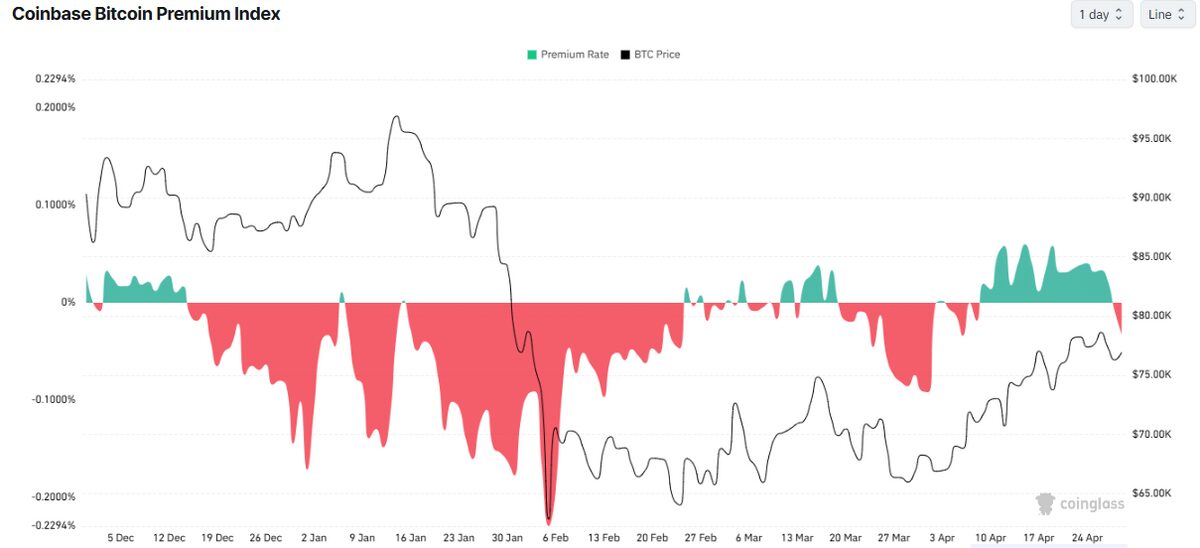
The Coinbase Premium Index, which tracks the price difference between BTC on Coinbase vs. global exchanges, flipped negative for the first time in three weeks. A negative reading signals that U.S.-based buyers are either absent or actively selling.
Sponsored
On-chain analytics firm CryptoQuant reports $829 million in seven-day net realized losses, compared to $566 million in realized profits over the same timeframe.
Meanwhile, Binance derivatives data showed $828 million in net sell volume on April 27—the weakest taker activity since late March. Crypto analyst Amr Taha notes the Bitcoin taker buy/sell ratio fell to 0.89, signaling aggressive selling over buying.
The Detail Most Coverage Skipped
The analyst notes that the current 0.89 ratio level matches the zone seen around March 29. At that time, BTC was testing $66,000. However, over the following 30 days, it rose by approximately 22% to $79,400 on April 27.
According to him, the current setup is “closer to a short-term capitulation or exhaustion zone” rather than a larger trend breakdown.
This signal does not indicate a bullish outlook. Instead, the data remains ambiguous, with the prevailing bearish narrative representing just one possible interpretation.
The key distinction lies between capitulation, in which forced selling clears out and potentially establishes a price floor, and distribution, in which informed holders exit positions amid strength.
Both scenarios can produce similar surface-level metrics, with differences emerging only in hindsight or through monitoring subsequent ETF flows.
Why Macro is Running This Trade
Bitcoin’s inability to clear $80,000 confirms it remains closely correlated with risk assets, particularly technology stocks, amid dominant macroeconomic influences. Expectations around Federal Reserve policy, high oil prices, and uneven Big Tech earnings are driving short-term movements.
Wider uncertainties, including interest rates, energy market swings, and Nasdaq positioning, continue to weigh on sentiment. Emerging evidence of softening AI demand, such as subdued OpenAI revenue figures, contributes additional downward pressure. Until that resolves, on-chain fundamentals are a secondary input.
Another structural tension worth noting is the fact that spot Bitcoin ETFs recorded nearly $1 billion in weekly net inflows recently, with BlackRock’s IBIT leading at $214M per day, showing a real institutional demand.
The Coinbase Premium going negative while ETF flows remain positive suggests institutions are buying through fund vehicles rather than directly on Coinbase, which partially explains the divergence.
What to Watch This Week
The Federal Reserve’s decision is scheduled for Wednesday. Market participants anticipate that any dovish signals or language indicating a policy pause could substantially ease macroeconomic pressures.
ETF flow data is due Thursday and Friday. Inflows holding above $500 million per week amid a negative premium would lend greater credibility to the capitulation scenario.
Conversely, a reversal in ETF flows while the premium remains negative would strengthen the distribution thesis.
Stay in the loop with DailyCoin’s popular crypto scoops:
Algorand’s Falcon Future: Bullish Enough To Double Price?
Bitcoin Fails $80K Breakout as Macro Forces Dominate Price Action
People Also Ask:
The Coinbase Premium Index measures the percentage price difference between Bitcoin on Coinbase and its price on other major global exchanges, primarily Binance. It is used as a proxy for U.S. institutional demand.
A negative reading means Bitcoin is trading cheaper on Coinbase than on global exchanges, signaling that U.S.-based buyers are either absent or actively selling at current price levels.
Capitulation is forced selling by holders who can no longer sustain losses, often marking a price floor. Distribution is informed holders exiting into strength. Both produce similar on-chain signals but have opposite implications for price direction.