
Tether has minted an additional $1 billion in USDT on the Tron network, according to on-chain tracking data from LookOnChain. The circulating supply of USDT on Tron has now reached $85.3 billion, surpassing Ethereum.
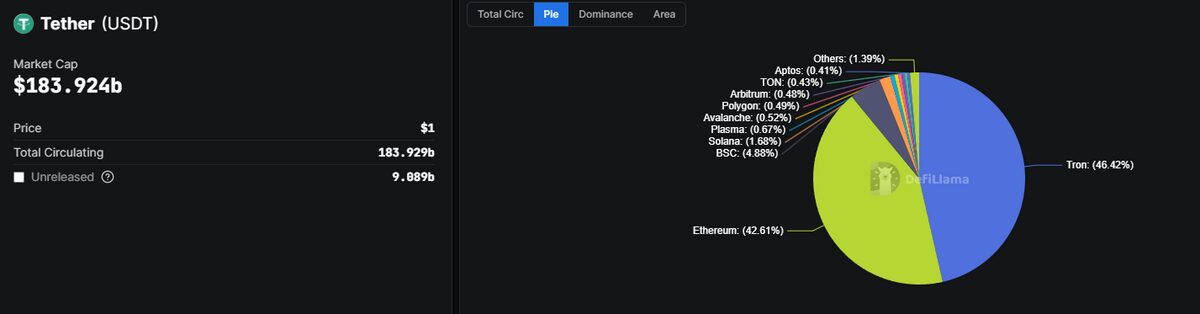
However, as of March 11, Tether’s official website reports that Tether’s total circulating USDT across multiple blockchains stood at approximately $184.9 billion. Ethereum leads with $92.38 billion, followed closely by Tron with $85.39 billion, together representing over 95% of the stablecoin’s total circulation.
Sponsored
Smaller balances are distributed across other networks, including Solana ($3.09 billion), Avalanche ($0.94 billion), Ton ($0.79 billion), Aptos ($0.76 billion), and others, underscoring Ethereum and Tron’s dominant role in global USDT liquidity and crypto market operations.
Stablecoin Issuance Trends
USDT holds more than 58.4% of the global stablecoin market, with over 46% of that supply issued on Tron, according to DefiLlama.
This level of minting is not unusual. At the end of January, Tether and Circle issued $1.5 billion in stablecoins on Tron and Solana. Tether contributed $1 billion primarily on Tron, while Circle minted around $500 million USDC, including new supply on Solana.
The issuances followed a sharp crypto market pullback that briefly pushed Bitcoin below $93,000 and triggered widespread liquidations. During such periods, stablecoins often act as liquidity buffers, allowing traders and institutions to park capital while awaiting market direction. USDT and USDC continue to dominate the stablecoin supply.
Tron now hosts over 369 million user accounts and supports up to 9 million daily transactions. The network facilitates an average of $27.5 billion in daily USDT transfers.
Tron supports cross-border USDT transfers, daily transactions, and stablecoin activity in multiple markets, with total value (TVL) locked at $23.44 billion.
USDC Activity on Ethereum
Meanwhile, USDC monthly transfer volume on Ethereum reached a record $1.7 trillion in February 2026, according to Token Terminal.
This represents roughly 250% growth year-over-year, highlighting Ethereum’s emergence as the leading financial settlement layer for stablecoin transactions online.
Regulatory Context
USDT activity on Tron has accelerated following the U.S. GENIUS Act, passed in July 2025. The law establishes the first federal rules for payment stablecoins. Issuers must be licensed, meet capital and reserve requirements, and comply with disclosure standards. Non-compliant stablecoins risk being barred from U.S. markets.
To comply, Tether launched USAT, a U.S.-regulated stablecoin issued through Anchorage Digital Bank. Its flagship USDT continues to operate globally but must meet comparable standards to be offered in the U.S.
Tether has faced past regulatory scrutiny. In 2021, it paid a $41 million fine to the CFTC over reserve claims and remains subject to ongoing compliance reviews.
Discover DailyCoin’s popular crypto scoops today:
Bear Market Keeps Pegging XRP’s Price: $2.80 Fantasy On Hold?
ETH Clings To $2K As Liquidations Fade & Buyers Show Up
People Also Ask:
USDT is a dollar-backed stablecoin used to transfer value quickly on blockchain networks. It provides price stability compared with volatile cryptocurrencies, making it widely used for trading, hedging, and cross-border transactions.
Minting USDT on Tron increases the stablecoin’s supply on a high-transaction blockchain, helping traders and institutions move capital efficiently. Tron’s network features low fees and fast settlements, supporting large-scale stablecoin transfers.
Laws like the U.S. GENIUS Act require stablecoin issuers to meet licensing, reserve, and disclosure standards. Compliance ensures coins like USDT can operate legally in regulated markets, influencing where and how they are issued.