

Key Takeaways
- Hyperliquid is a high-performance perpetuals DEX launched in 2023, built on its own Layer-1 chain with deep liquidity and fully on-chain order books supporting sub-millisecond latency.
- Automated trading bots on Hyperliquid are increasingly popular for perpetual futures, enabling 24/7 execution, market-neutral strategies, and faster reactions than manual trading.
- Today’s Hyperliquid bots range from no-code rule engines to advanced algorithmic and market-making systems, accessible via api keys or wallet-based connections.
- Most bots focus on automated strategies such as grid trading, DCA, arbitrage, and funding-rate plays, often running across multiple connected exchanges in parallel.
- WunderTrading is one of the platforms that recently integrated Hyperliquid, adding bot support and offering Hyperliquid users a permanently free Premium plan, though this article focuses on the broader ecosystem.
What Is Hyperliquid and Why Are Bots Gaining Traction?
The hyperliquid exchange operates as a non-custodial, order-book based perpetuals decentralized exchange running on its own Layer-1 blockchain. Unlike AMM-based DeFi protocols, the hyperliquid platform uses a central limit order book that supports transparent matching and execution without intermediaries. The architecture advertises hundreds of thousands of orders per second with sub-millisecond latency—performance metrics that position it closer to centralized exchange experiences than typical DeFi alternatives.
Since its late 2023 launch, trading on hyperliquid has expanded rapidly. Daily volumes grew from under $1 billion in early 2024 to peaks exceeding $10 billion by mid-2025. The platform offers hyperliquid perps on over 100 crypto pairs with leverage up to 50x, naturally attracting algorithmic and quant-driven hyperliquid traders who require precise execution and deep liquidity.

The 24/7 nature of crypto markets combined with perpetual futures volatility creates strong demand for bots that can react instantly to market price movements, funding rate shifts, and liquidity fluctuations. Manual trading struggles against these rapid changes. An estimated 40-60% of Hyperliquid’s volume is now attributed to algorithmic activity, mirroring trends on major centralized venues.
Sponsored
Compared with many DeFi AMM perps, Hyperliquid replicates a CEX-like trading experience on-chain, which lowers the barrier for active traders who already use bots on centralized exchanges to migrate their automation workflows to a non custodial security environment.
How Hyperliquid Trading Bots Work in Practice
A hyperliquid trading bot is software that connects to the Hyperliquid protocol via hyperliquid api keys, smart accounts, or wallet signatures to place, modify, and cancel orders based on predefined rules and logic. These bots enable systematic, emotion-free execution across market conditions.
Most bots run off-chain on servers, VPS instances, or cloud platforms, communicating with Hyperliquid’s matching engine through REST or WebSocket APIs. They monitor:
- Order books and market data in real time
- Funding rates (settled every hour)
- Open positions and account balances
- Mid-prices and liquidity depth
Traders define rules such as price thresholds, indicator conditions (RSI below 30, moving average crossovers), and position limits. The trading bot continuously evaluates these against live data and triggers buy and sell orders when conditions are met.
More advanced users operate market-making, latency-sensitive, or arbitrage systems that rely on millisecond-level order-book updates. These require robust error-handling to ensure consistent inventory and risk management. While bots can be highly automated, they still require configuration: setting leverage, maximum drawdown thresholds, allowed trading pairs, and capital allocation per strategy to align with individual risk tolerance and trading style.
Core Advantages of Using a Hyperliquid Bot
The appeal of crypto trading bots on Hyperliquid stems from efficiency, discipline, and the platform’s technical design. Several key benefits drive adoption among both retail and institutional participants.
Automated execution around the clock:
- Bots run 24/7 without manual monitoring
- Eliminate missed entries during overnight sessions or major news events
- Maintain positions through weekends when markets remain active
Speed and consistent execution:
- Algorithms submit and cancel orders in fractions of a second
- Fast execution reduces slippage during volatile periods
- Strict adherence to predefined rules removes emotional decision-making
Market-neutral and hedged approaches: Many bots focus on funding-rate arbitrage, basis trades, and delta-neutral strategies intended to capture small but frequent returns independent of overall market direction. These approaches can generate profit in sideways markets where directional traders struggle.
Strategy diversification: A single hyperliquid account can run multiple bots simultaneously—perhaps a conservative dca bot, a short-term breakout system, and a grid bot on range-bound pairs—spreading risk across different algo trading strategies.
Enhanced monitoring and reporting: Bots log every order, fill, and position change. This data supports performance analysis, parameter optimization, and refinement of risk controls through metrics like Sharpe ratios and maximum drawdown tracking.
Popular Hyperliquid Bot Strategies and Use Cases
While specific parameters vary by trader, certain strategy archetypes have become common across the Hyperliquid ecosystem. Each approach suits different market conditions and risk profiles.
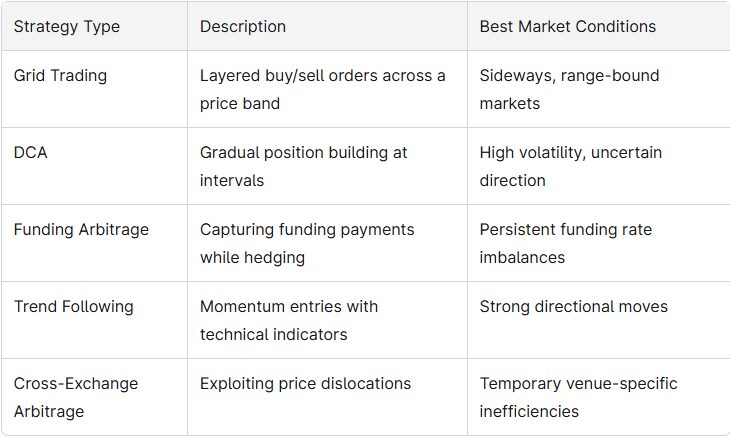
A hyperliquid grid trading bot places layered sell orders above and buy orders below the current price, profiting from oscillations. Backtested grid strategies on sideways pairs have shown 15-30% annualized returns net of trading fees in 2025 simulations.
The hyperliquid dca bot gradually builds long or short exposure by executing fixed-size orders at intervals or specific drawdown levels, smoothing entry prices and reducing timing risk.
Funding-rate and basis strategies involve bots monitoring funding payments on Hyperliquid while potentially hedging on other venues. These approaches capture yield while attempting to stay market-neutral.
A hyperliquid copy trading bot or copy trading strategy parses target wallet activity, mirroring trades from successful traders through whale tracking mechanisms. Some implementations claim 2-5x benchmark outperformance when following skilled quants, though results vary significantly.
A hyperliquid arbitrage bot compares prices across Hyperliquid and centralized exchanges, executing on dislocations greater than 0.05% net of round-trip costs. The signal bot approach uses TradingView webhooks to trigger entries based on external indicators.

Setting Up a Hyperliquid Bot: From Account to Live Deployment
Setting up a bot for hyperliquid involves several steps. Traders should follow security best practices and test on small positions before scaling.
Account creation: Connect a supported EVM wallet (MetaMask or similar) and sign an on-chain transaction to initialize. Ensure proper backup of seed phrases—this is the foundation of non custodial security.
Funding the account: Bridge USDC from Arbitrum or other supported chains into Hyperliquid’s environment. Bridge costs typically range from $1-5 depending on network congestion. High-frequency bot operators should factor latency and costs into their infrastructure planning.
API or wallet-based connection: Generate restricted api keys or use an api wallet approach where the platform supports it. Best practices include:
- IP whitelisting when available
- Limiting permissions to trading only (no withdrawals)
- Enabling 2FA on connected services
- Reviewing provider security documentation
Infrastructure considerations: Experienced traders often run bots on a VPS or dedicated server close to Hyperliquid’s infrastructure to reduce latency. AWS us-east-1 or similar regions can achieve sub-50ms ping times.
Recommended deployment approach: Start with demo mode or paper trading to validate strategy logic. Deploy with very small real funds ($100-1,000 initially) while monitoring logs closely. Scale capital only after verifying behavior under live market conditions with actual funding and swap fees.
Risk Management and Limitations of Hyperliquid Bots
While bots enhance efficiency, they do not eliminate market risk and can amplify losses if poorly configured. Understanding limitations is essential for anyone deploying advanced trading strategies on Hyperliquid.
Built-in risk controls: Most hyperliquid grid bot and other strategy implementations include:
- Position-level stop losses (typically 1-20% configurable)
- Take profit targets (5-100% of position gains)
- Account maximum drawdown limits (5-50%)
- Position size caps relative to account equity
- Manual mode overrides for emergency intervention
Technical and operational risks: Internet outages, API downtime (rare, but possible), and bugs in strategy code can cause deviations from backtested performance. Extreme slippage during sudden liquidations may trigger unexpected losses—both manual orders and automated ones face this challenge.
Cost considerations: Hyperliquid’s fee structure includes taker fees at 0.045% standard (reducible via volume tiers to as low as 0.0045%), plus funding payments that can accumulate significantly on leveraged positions. High-turnover strategies may see 10% or more annual drag from trading fees alone if not carefully optimized.
Testing requirements: Backtesting on historical data should incorporate fees, funding, and realistic slippage models. Forward testing with small capital reveals how strategies perform under live conditions. On chart orders visualization helps traders understand execution patterns before scaling.
Traders must manage positions actively, reviewing performance regularly, pausing bots during major network upgrades, and updating parameters as market conditions evolve. Full control requires ongoing oversight, not just initial setup.
WunderTrading’s Recent Integration of Hyperliquid
WunderTrading is among the platforms that recently integrated the hyperliquid exchange, adding support for automated trading tools and bot strategies in early 2026. Through this integration, traders can connect their hyperliquid accounts to WunderTrading and deploy bots including DCA, grid, arbitrage, and scalping strategies directly on Hyperliquid’s perpetual markets.
According to WunderTrading’s current terms, users who trade on Hyperliquid through the platform receive access to the Premium plan for free permanently, which includes strategy templates, advanced automation features, and expanded monitoring capabilities. No coding skills required for basic deployments.
WunderTrading represents one option among several in a growing ecosystem of Hyperliquid bot providers. Traders should compare swap fee discounts, security practices, and feature sets across platforms before committing to any specific solution. Other options include the goodcryptoX app, Hummingbot’s open-source connectors, and various GitHub repositories for custom implementations.
Broader Trends: Algorithmic Trading on the Hyperliquid Ecosystem
Bots on hyperliquid reflect a wider shift toward algorithmic and quant-driven trading across crypto derivatives markets since 2020-2021. Hyperliquid’s design—on-chain order book, transparent data feeds, and fast matching—aligns with institutional requirements for systematic strategies without centralized custodians.
Over 2024-2026, an increasing share of Hyperliquid volume is believed to be algorithm-generated, mirroring CEX trends where quantitative traders dominate derivatives flow. This has spawned an ecosystem of tooling:
- Open-source connectors and SDKs
- No-code bot builders requiring no coding skills
- TradingView webhook integrations for tradingview strategies
- AI-assisted strategy generators advertising Hyperliquid compatibility
- Access to hyperliquid vaults and structured products
The likely future direction includes more complex cross-venue arbitrage, tighter spreads from professional market makers, growing use of machine-learning models for adaptive parameters, and enhanced dashboards for multi-strategy portfolios. Debates continue around latency advantages, trading rewards distribution, and market stability during extreme volume surges.
For traders looking to start automating their strategies, the expanding ecosystem provides options across skill levels—from those seeking simple rule-based automation to those building sophisticated proprietary systems. Understanding platform mechanics, managing risk appropriately, and staying ahead of market changes remain essential regardless of which tools traders choose to deploy.
FAQ
Are Hyperliquid trading bots suitable for beginners?
Many Hyperliquid bots now offer no-code interfaces and strategy templates (basic DCA or grid setups), which lowers the entry barrier for beginners. However, users should understand leverage mechanics, liquidation risk, and fee structures before deploying real funds. Starting with demo mode and small positions helps build familiarity without significant capital exposure.
Do I need coding skills to run a Hyperliquid bot?
Coding skills are not strictly required. Several platforms provide visual rule builders and pre-configured strategies for Hyperliquid that work without programming knowledge. More advanced traders can write custom code in Python, JavaScript, or other languages for full control over strategy logic and execution parameters.
Can the same bot strategy run on Hyperliquid and other exchanges simultaneously?
Many bot frameworks support multi-exchange execution, allowing traders to deploy identical logic on Hyperliquid, centralized exchanges, and other perps DEXs simultaneously. This approach requires managing separate API keys, position limits, and risk parameters per venue. Cross-exchange arbitrage strategies specifically leverage this capability.
How do fees and funding rates affect Hyperliquid bot performance?
Each trade incurs maker/taker fees (0.045% taker standard, with volume-based reductions available). Perpetual positions pay or receive funding at hourly intervals—often 0.02-0.1% during bull markets when longs pay shorts. Bots with high turnover or large notional exposure need to factor these costs into backtests and live monitoring to ensure strategies remain profitable after expenses.
Is it safe to share my Hyperliquid API keys with a third-party bot platform?
Safety depends on the platform’s security practices. Traders should restrict API permissions to trading only, avoid enabling withdrawals, use IP whitelisting where possible, and enable two-factor authentication on connected services. Reviewing the provider’s track record, documentation, and security certifications before granting access helps minimize exposure to potential compromises.
This article contains sponsored content from an external source. The opinions and information presented may differ from those of DailyCoin. Readers are encouraged to independently verify the details and consult with experts before acting on any information provided. Please note that our Terms and Conditions, Privacy Policy, and Risk Warning have been recently updated.