

Some of the smartest people in the Oval Office said that the frustration in Washington signals an impending compromise on the Clarity Act. If that’s the case, Ripple’s CEO Brad Garlinghouse expects the issues on the The Digital Asset Market Clarity Act to solve faster than most crypto market connoisseurs think.
High Frustration Points Push Closer To a Compromise
Talking to Semafor’s Jax Alemany at the World Economy Summit last week, Ripple’s CEO explained his belief that “When people are at their peak frustration, that’s when they finally compromise, and it gets done,” – signaling an optimistic belief in comparison to Coinbase’s CEO Brian Armstrong & many others.
For Ripple, the Clarity Act is crucial as it splits the field of authority between the CFTC & the SEC in a very clear way. In such a way, the enforcement-based approaches as seen previously under Gary Gensler’s regime cannot be maintained, replacing them with more effective legal frameworks for crypto’s adoption.
Surely, the ongoing stand-off between banking institutions and crypto firms has slowed the pace of adoption, even though the Clarity Act was granted approval in late 2025 by the White House. Currently at the Senate Banking Committee’s table, this legal framework is stuck due to banks denying stablecoin yields, as well as numerous potential DeFi centralization issues.
Ripple Readies a Black Horse To Fast-Track Adoption
In Ripple’s case, XRP would lose the long-term shadow of being treated as a security – a clear commodity status enables further Wall Street adoption, as well as XRP Ledger’s integration within federal infrastructure corridors with XRP as the main bridge asset. However, it’s fair to note that the Clarity Act is mostly focused around stablecoins – RLUSD is the name of the game.
Since launching their own stablecoin last Summer, Ripple’s RLUSD gained institutional traction around the same time when the inaugural Ripple-based ETFs dropped. The stablecoin garnered the first $1 billion in market capitalization in two months since inception, constantly whipping up around $150 million in daily trading volume, now encircling a $1,476,318,808 market cap.
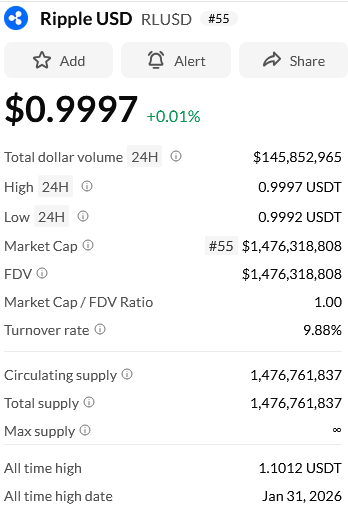
If the Clarity Act plays out faster than mid May, 2026, the global merging of traditional & digital finance could spark up a rally for the major-cap coins.
The utility-driven narrative this year is tackling both Distributed Ledger Technology (DLT) assets & privacy coins, opening a new wave of utility-driven market depth, given that the regulatory headwinds fall in place without much delay.
Stay in the loop with Dailycoin’s top crypto scoops:
CoW Swap DNS Attack Enters Day Two as Domain Remains Locked
X Cahstags Rolls Out in US and Canada. What Changes for Traders?
People Also Ask:
In a new interview, Brad Garlinghouse expressed strong optimism that the CLARITY Act (a major U.S. crypto regulation bill) is almost ready to pass. He said, “I think we’re there.”
It’s a bill in the U.S. Congress that aims to bring clear rules for cryptocurrencies. It would make it easier for companies like Ripple to operate in America and give the whole crypto industry more regulatory certainty.
Garlinghouse believes that after years of frustration and back-and-forth in Washington, lawmakers are finally ready to compromise and get the bill done. He said compromise usually happens when people are at their “peak frustration.”
If the Clarity Act passes, it would be very positive for Ripple and XRP. It could reduce legal uncertainty, attract more banks and institutions, and potentially boost XRP’s real-world use and price.
Keep an eye on DailyCoin news from the Congress in the coming weeks. If the Clarity Act bill moves forward quickly, it could create a lot of excitement in the crypto market.