

Japan’s central bank raised its policy rate on Tuesday, extending a gradual but historic shift away from more than three decades of ultra-loose monetary policy and bringing borrowing costs to levels last seen in the mid-1990s.
The Bank of Japan (BOJ) increased its benchmark rate by 25 basis points to around 1.0%, marking a continuation of its post-2024 normalization cycle. It is the first time since 1995 that Japanese interest rates have reached the 1%.
Sponsored
The move also follows December’s increase to 0.75%, reinforcing the BOJ’s incremental tightening path after years of yield suppression and large-scale asset purchases.
Inflation Pressures Driven by Energy and Currency Weakness
Officials said the decision reflects growing concern that external shocks are feeding into domestic price dynamics, particularly via energy costs and currency weakness.
Inflationary pressure remains elevated as geopolitical tensions linked to the Iran-related oil shock keep global energy prices high. Japan’s wholesale inflation rose to 6.3% in May, the highest reading since March 2023, according to BOJ data released Wednesday.
Policy makers have warned that persistent cost-push inflation risks becoming more embedded in the domestic economy if the yen remains weak and imported energy prices stay elevated.
Japan’s Exit From Ultra-Loose Policy Gains Momentum
The BOJ’s latest move extends a policy reversal that began in 2024 after more than a decade of extreme monetary easing.
In 2013, the central bank launched its Quantitative and Qualitative Easing (QQE) program to revive growth and inflation expectations through large-scale asset purchases. The framework expanded further in 2016 with negative interest rates and yield curve control aimed at anchoring 10-year government bond yields near zero.
That ultra-loose stance began to unwind in March 2024, when the BOJ exited negative rates and initiated its first hike in years.
A growing number of economists now expect rates to reach 1.25% by Q4 2026 and 1.50% by mid-2027, marking a steady path of tightening.
Higher Japanese Rates Threaten Liquidity-Fueled Risk Trades
For global investors, the shift carries implications far beyond Japan.
For decades, Japan’s near-zero interest rates enabled one of the most widely used global funding strategies: borrowing cheaply in yen and investing in higher-yielding assets abroad, including US Treasuries, equities, and cryptocurrencies.
This so-called carry trade has been a structural source of liquidity for risk assets. But it becomes less attractive as Japanese yields rise and the yen strengthens, increasing both funding costs and currency risk.
The International Monetary Fund (IMF) warned in its April 2026 Global Financial Stability Report that the unwinding of these carry trades can amplify market volatility by disrupting capital flows, increasing bond yield fluctuations, and stressing leveraged positions and non-bank financial institutions.
Each additional BOJ rate hike therefore reduces the incentive to maintain yen-funded leverage in global markets, gradually tightening liquidity conditions across asset classes.
Bitcoin Holds Above $65,000 as Markets Look Past BOJ
Crypto markets showed a muted reaction to the decision.
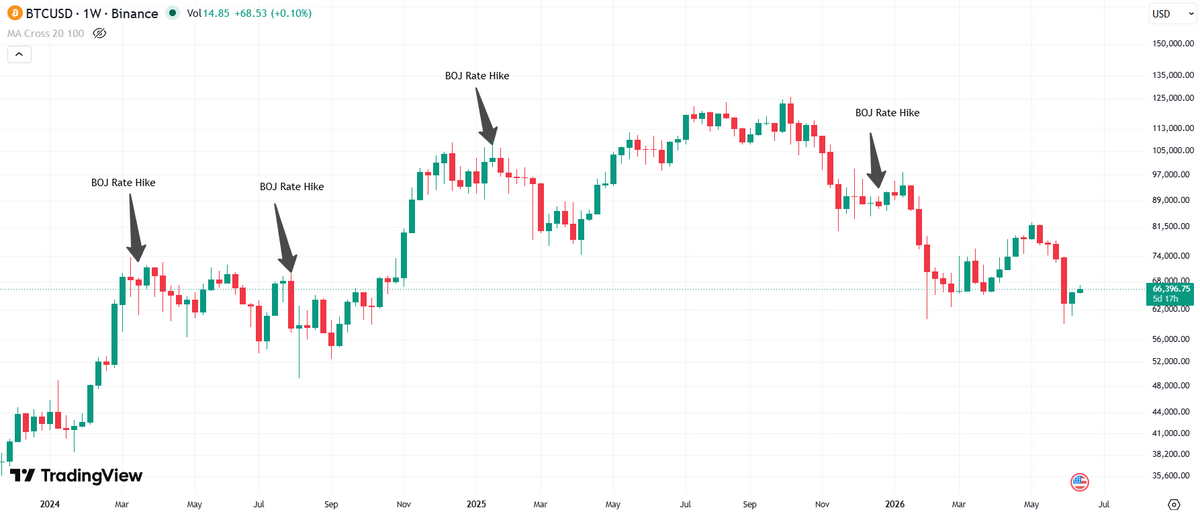
Bitcoin (BTC) remained above $66,000 following the announcement, with traders appearing more focused on geopolitical developments, including progress in US–Iran diplomatic talks, than on Japan’s policy move.
Historically, however, BOJ tightening cycles have coincided with periods of stress in risk assets.
Since the central bank began raising rates in March 2024, Bitcoin has often seen sharp post-announcement drawdowns, with declines averaging roughly 27% in prior episodes.
n August 2024, for example, Bitcoin dropped from $70,000 to around $57,000 within a week amid concerns over a broader unwind of yen-funded carry trades.
Reduced Cushion Compared to Previous Cycles
Despite the relatively stable immediate reaction this time, market positioning remains more fragile than in earlier phases of the cycle.
Bitcoin is already more than 50% below its October 2025 highs heading into the latest BOJ decision, leaving less of a buffer against renewed volatility compared with previous tightening episodes.
Still, the risk is not immediate. Carry trade unwind effects tend to appear with a lag, as funding costs and positioning adjustments typically unfold over days and weeks rather than in the first hours after a policy decision.
A Structural Shift in Global Liquidity Conditions
The BOJ’s latest hike reinforces a broader transition away from Japan’s era of ultra-cheap funding, that helped sustain global risk appetite for more than a decade.
The greater risk lies in future tightening. Each upcoming BOJ meeting now has the potential to act as a volatility trigger for global markets, and crypto particularly, through its impact on leverage, liquidity, and cross-border funding flows.
Check out DailyCoin’s hottest crypto news now:
XRP Adoption Takes Off In Europe, But Banks Want It Simple
HBAR’s 0.74 Upgrade Targets ‘State Bloat’, Whales Move In
People Also Ask:
The BOJ rate hike refers to the Bank of Japan increasing its benchmark interest rate. It matters because it signals a shift away from ultra-loose monetary policy that has shaped global liquidity conditions for years.
A BOJ rate hike can affect Bitcoin by tightening global liquidity. Higher Japanese interest rates reduce the attractiveness of yen-funded carry trades, which have historically supported risk assets including cryptocurrencies.
The yen carry trade is a strategy where investors borrow money in Japan at very low interest rates and invest it in higher-yielding assets such as stocks, bonds, or crypto. It is sensitive to BOJ rate changes.