

- Crypto stocks showed higher volatility than Bitcoin in 2026
- Institutional demand grew despite increased equity market risks
- Crypto equities add company-specific risks beyond Bitcoin exposure
Investors poured millions into crypto-related stocks this year expecting regulated equity exposure to provide a safer way to access digital assets. New market data, however, shows that many of these stocks have been significantly more volatile than Bitcoin itself.
Crypto stocks are publicly traded companies whose businesses are connected to cryptocurrencies, including exchanges, stablecoin issuers, Bitcoin treasury companies, and mining firms.
Sponsored
Crypto equities have gained popularity among institutional investors because they offer exposure to the digital asset sector through traditional brokerage accounts, while also providing access to company revenues linked to trading, custody, stablecoins, and mining.
Institutional demand for crypto equities has remained strong despite market volatility. In June alone, ARK Invest purchased approximately $77 million worth of crypto stocks, including $44 million in Coinbase (COIN), $25.25 million in Circle (CRCL), and $8.2 million in Bullish (BLSH).
Crypto Stocks Showed Higher Volatility Than Bitcoin
While Bitcoin recorded a 30-day realized volatility of 37.6%, most major crypto-linked stocks experienced substantially larger price swings.
Coinbase, Circle, Robinhood, and other crypto-related stocks recorded volatility figures ranging from roughly 68% to nearly 90%, indicating that their share prices experienced larger swings than Bitcoin over the same period, according to analysis published by Nadcab Labs, a blockchain technology company.
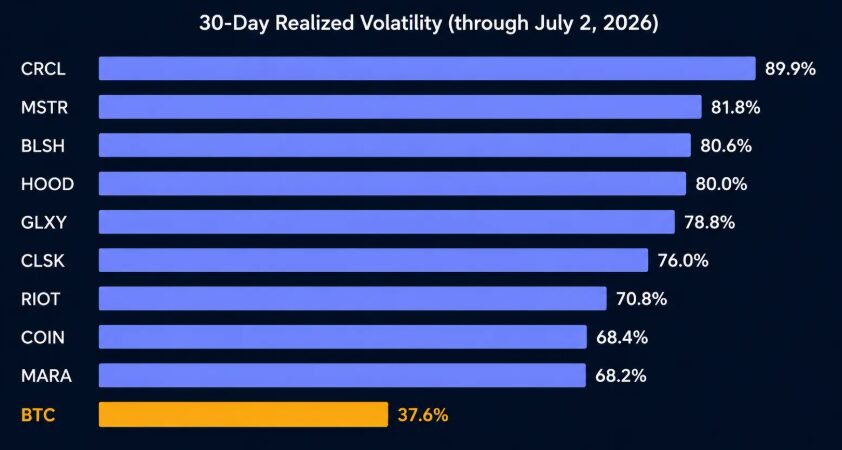
Among the companies analyzed, Circle (CRCL) experienced the highest volatility at 89.9%, followed closely by MicroStrategy (MSTR) at 81.8% and Robinhood (HOOD) at 80.0%. CleanSpark (CLSK) recorded 76.0% volatility, while Riot Platforms (RIOT) and Coinbase (COIN) registered figures of 70.8% and 68.4% respectively.
The figures suggest that investors seeking indirect exposure to the crypto market through equities may still face significantly higher volatility than holding Bitcoin itself.
Not All Crypto Stocks Track Bitcoin Equally
The analysis also found notable differences in how closely individual stocks moved with Bitcoin.
Strategy remained the closest Bitcoin proxy among public companies, posting a correlation coefficient of 0.85. Coinbase followed at 0.75, while Robinhood and Circle recorded lower correlations of 0.58 and 0.55, respectively.
The weaker correlations indicate that company-specific factors often play a major role in determining stock performance. Revenue growth, regulatory developments, competitive pressures, and broader equity market conditions can all influence returns independently of Bitcoin’s price action.
Strategy represents the closest publicly traded Bitcoin proxy among major companies, with its balance sheet dominated by cryptocurrency holdings. The company holds 843,775 BTC as of July 7.
Mining Stocks Diverged From Bitcoin Performance
Bitcoin miners also demonstrated that crypto stocks can behave differently from the underlying asset.
Despite Bitcoin posting a year-to-date decline of 29.5%, several mining companies delivered strong gains. Riot Platforms rose 74.5%, MARA Holdings gained 38.1%, and CleanSpark advanced 24.7%.
Investors have increasingly linked miner valuations not only to Bitcoin prices but also to expectations around artificial intelligence and high-performance computing infrastructure, which have become an additional growth narrative for mining companies beyond crypto exposure.
Investors Face Multiple Layers of Risk
The data highlights a key distinction between Bitcoin and crypto-linked equities. While both are influenced by developments in the digital asset market, publicly traded companies carry additional operational, financial, regulatory, and management risks.
As institutional investors continue allocating capital to crypto stocks, the latest volatility figures suggest that equity exposure does not necessarily provide a less risky alternative to holding Bitcoin directly. In several cases, investors may be assuming greater risk while remaining exposed to many of the same market forces that drive cryptocurrency prices.
Check out DailyCoin’s popular crypto scoops right now:
Polymarket Lawsuit Over BTC Sale Bet: Traders Dispute $797K Market Settlement
SWIFT Brings Back ‘Policy Lab’, Fast-Tracking XRP Adoption
People Also Ask:
The data suggests that the answer depends on the company. While crypto equities provide regulated access to the sector, they also introduce additional risks related to business performance, regulation, and management decisions.
Crypto stocks can be influenced by both cryptocurrency market movements and traditional stock market factors, including earnings, investor sentiment, competition, and regulatory developments.
Crypto stocks are shares of publicly traded companies connected to the cryptocurrency industry, including exchanges, stablecoin companies, Bitcoin treasury firms, and crypto mining companies.