

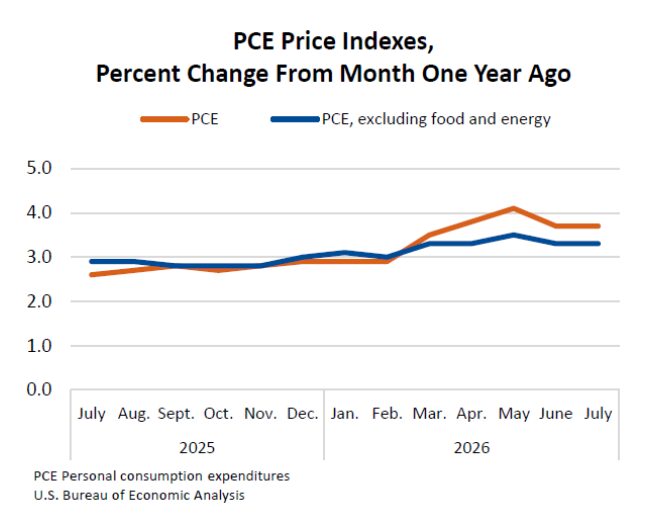
- July PCE inflation rose 3.7% year-over-year, above the 3.6% forecast
- Bitcoin fell to $78,600 as Treasury yields and the dollar rose
- Traders now await Kevin Warsh’s Jackson Hole speech on Friday
Bitcoin (BTC) faced renewed macro pressure on August 26 after U.S. inflation remained above the Federal Reserve’s target, while softer consumer spending added to concerns about economic momentum.
The data left investors weighing whether the Fed will prioritize inflation control or a slowing economy, with Chair Kevin Warsh’s Jackson Hole speech now the next major policy event.
PCE Inflation Climbs to 3.7%, Above Forecasts
The U.S. Bureau of Economic Analysis (BEA) reported on August 26 that personal income rose 0.4% in July, with after-tax income up 0.5%.
Sponsored

Consumer spending grew just 0.2%, a notably slower pace than income growth. The PCE price index climbed 3.7% from a year earlier, above the 3.6% consensus estimate and nearly double the Fed’s 2% inflation target.
Bitcoin Falls Below $78,600 as Yields Rise
Equity markets showed little immediate reaction, but bond and currency markets moved more visibly.
The 10-year Treasury yield rose to roughly 4.65%, and the U.S. dollar strengthened following the data.
Gold fell about 0.86% to near $4,598 per ounce, reflecting reduced appetite for non-yielding assets.
Bitcoin declined below $78,600 in the hours after the release, while the broader crypto market held roughly flat, up 0.2% over 24 hours with total market capitalization near $2.746 trillion.
Markets Await Warsh’s Jackson Hole Address
Despite the hotter inflation print, equities barely moved, suggesting investors are holding off on positioning until Fed Chair Kevin Warsh speaks at the Jackson Hole Symposium on Friday.
Kevin Warsh’s Jackson Hole address is expected to provide a clearer indication of how the Fed views inflation, interest rates and economic growth. It will be Warsh’s first appearance at the symposium as Fed chair.
If Warsh stresses inflation risks, markets could expect rates to stay higher for longer, weighing on Bitcoin and other risk assets.
If he focuses on slowing growth and consumer demand, rate-cut expectations could strengthen, supporting liquidity, risk appetite and potentially crypto.
Yet, the Fed’s long-standing target of 2% average annual inflation, measured via the PCE index, now sits at 3.7%.
The 30-year Treasury yield recently touched roughly 5.31%, prompting the Treasury to increase purchases of longer-dated bonds.
Warsh has also stepped back from traditional Fed forward guidance, and Reuters has noted this shift has made Fed policy harder for investors to interpret, adding to upward pressure on long-term yields.
Why This Matters
Bitcoin is increasingly sensitive to changes in U.S. monetary-policy expectations, particularly through Treasury yields and liquidity conditions. If Kevin Warsh prioritizes fighting inflation, higher-for-longer rates could weigh on crypto markets, while signals toward supporting growth could reignite risk-asset demand.
Dive into DailyCoin’s hottest crypto scoops:
Crypto Advocacy Group Backs 32 CLARITY Act Supporters
Ripple CEO: $16 Trillion In Motion Shows Visa-Scale Reach