

Former Apple CEO Tim Cook has entered the conversation as a potential successor to Jensen Huang after Yale professor Jeffrey Sonnenfeld floated his name in Time magazine, citing Cook’s unique track record following a major tech founder.
Now serving as Apple’s executive chairman after stepping down in September, Cook is drawing speculative interest on prediction markets as reports surrounding Huang’s personal life and an alleged Chinese intelligence link spark boardroom scrutiny at the world’s largest chipmaker.
Why Tim Cook Fits the Nvidia CEO Profile
When Sonnenfeld weighed potential outside replacements alongside former Google CEO Eric Schmidt, Cook stood out for several practical reasons that mirror Nvidia’s current position:
- Experience succeeding a legendary founder. In 2011, Cook took over Apple from Steve Jobs amid widespread doubts that the company could sustain its momentum without its visionary co-founder. He went on to lead Apple through a historic era of growth. Nvidia faces a similar dynamic, as Huang remains deeply tied to the company’s identity and strategy.
- Supply chain and geopolitical mastery. Cook spent decades navigating complex Asian manufacturing networks and delicate U.S.–China trade relations—two areas critical to Nvidia’s survival and growth.
- Sudden availability. Having handed Apple’s CEO role to John Ternus in September 2026, Cook now holds a less operational executive chairman position, giving him theoretical flexibility that he lacked just months ago.
Still, there is no indication that Nvidia has approached Cook or that he is actively seeking the job. And to understand why succession is even being discussed, it helps to look at the controversy unfolding inside Nvidia’s boardroom.
What Triggered the Nvidia Leadership Scare
Since November 8, media reports have alleged that Huang had an affair with a woman suspected of ties to Chinese intelligence—a relationship he reportedly acknowledged in a letter to staff.
The revelations have raised immediate questions around national security risks and executive succession. In response, Nvidia’s board launched an independent investigation, sending Nvidia shares down more than 8% in after-hours trading.
While the board investigates, prediction market traders are already betting aggressively on how soon Huang could step down—and who might replace him.
Polymarket and Kalshi Odds Point to a Huang Exit
On Polymarket, traders are giving an 88% chance that Huang leaves his position by December 31, with the year-end contract drawing more than $4.7 million in volume.
Bettors also place 59% odds (across $2.43 million in volume) on an announcement happening as soon as today, November 12. On Kalshi, 63% of bettors expect Huang to depart by November 15.
Trading is equally active in the successor markets, though insiders currently lead the pack.
On Kalshi current Nvidia CFO Colette Kress leads at 30%, closely followed by Ian Buck, who runs Nvidia’s hyperscale and high-performance computing business, at 29%. Tim Cook sits at 5%.
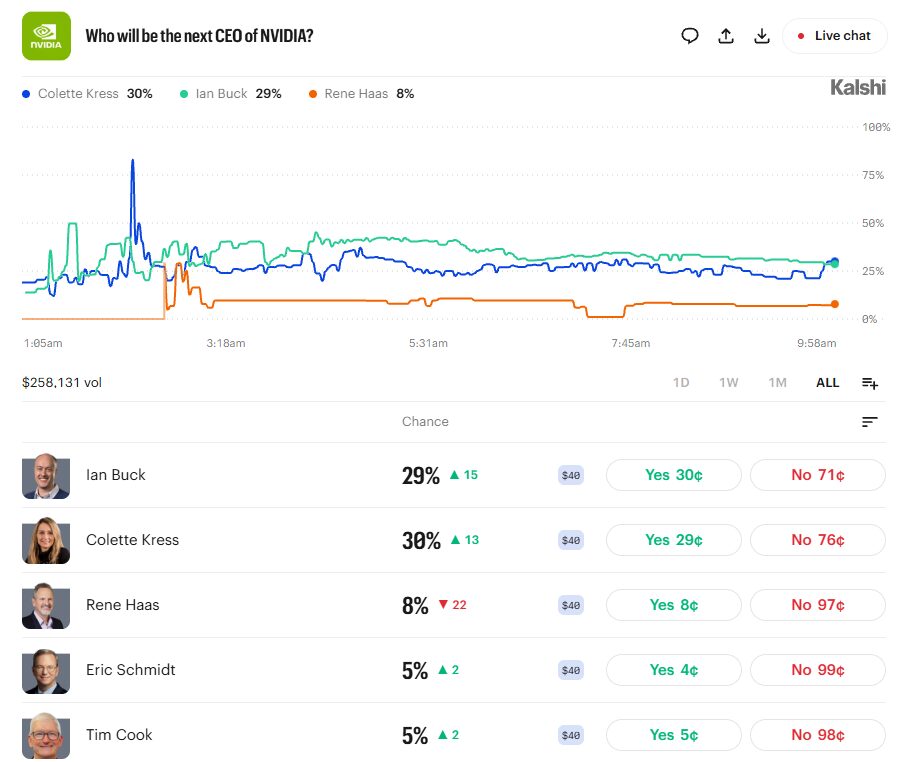
On Polymarket, Buck holds the top spot at 25%, just ahead of Kress at 22%.
Why This Matters
Because Nvidia sits at the center of the global AI trade, sudden leadership uncertainty ripples far beyond a single stock. Alongside Nvidia’s after-hours drop, broader tech equities and AI-linked crypto assets, including Nvidia-linked crypto derivatives and tokenized stocks, have already posted losses as markets brace for what comes next.
Dive into DailyCoin’s popular crypto news today:
Does Holding Crypto Put Your Social Security Payments at Risk in 2026?
Why Is Bitcoin Down Today? Key Factors Behind BTC’s Slide Toward $73K