
Prediction markets are entering a new competitive phase in 2026. After platforms such as Polymarket and Kalshi demonstrated demand for trading real-world outcomes, a new generation of crypto prediction markets and event-trading platforms has begun emerging, offering alternatives for users looking beyond the established leaders.
These platforms are taking different approaches — from fully on-chain markets and DeFi-native infrastructure to regulated trading products and exchange-style trading systems.
Sponsored
The latest prediction markets are competing on more than event coverage. New platforms are experimenting with different settlement models, trading tools, liquidity systems, and incentive structures designed to attract traders and market participants.
This list examines emerging prediction market platforms shaping the sector in 2026, comparing their models, key differentiators, and remaining limitations
1.Outpoll
Outpoll is a new CeDeFi prediction market platform with a trading-focused approach, combining event contracts with exchange-style features such as advanced order types and API access.
Users can trade Yes/No contracts on real-world events spanning politics, sports, finance, crypto, entertainment, and culture.
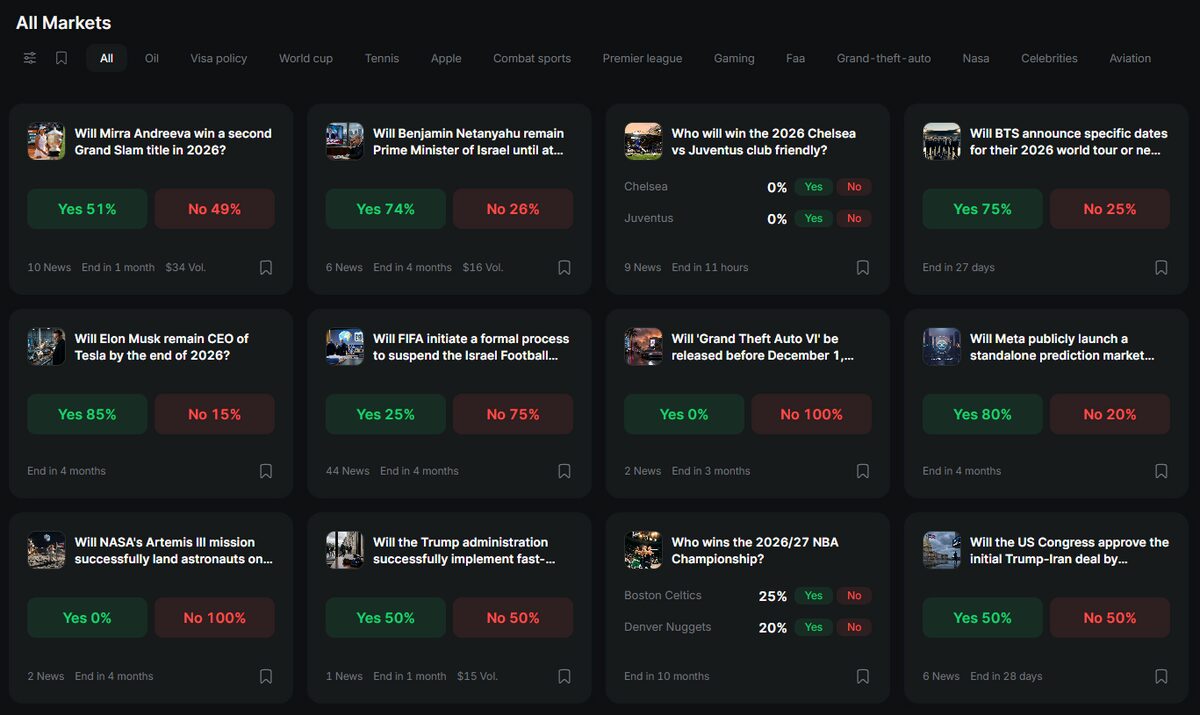
From a user perspective, Outpoll functions similarly to a traditional binary prediction market. Users can deposit USDC, fiat currencies, or cryptocurrencies, which are converted into USDC for settlement. They can then purchase YES or NO outcome tokens that are designed to be fully collateralized at a 1:1 ratio to USD-equivalent value.
The platform uses a hybrid CeDeFi model, combining centralized trading execution with blockchain-based settlement. Outpoll states that its infrastructure runs on a proprietary blockchain designed for speed, scalability, and security.
The company has indicated that future plans may include migrating to another blockchain network or making its own blockchain publicly available after further testing.
Outpoll charges a 0.1% trading fee and provides exchange-style tools, including limit orders, market orders, take-profit orders, and stop-loss orders.
It also offers a public REST and WebSocket API that allows traders to automate strategies, manage positions, monitor markets in real time, and integrate the platform with their existing trading tools. This makes Outpoll relevant for users looking for a prediction market API rather than only a consumer-facing betting interface.
Following the release of its second app version in July, Outpoll says future development plans include a rewards center, an iOS application, and creator-led markets that would allow influencers and content creators to launch their own prediction markets.
The platform is currently available through a native Android application on Google Play. Its native Outpoll Token is distributed directly to user accounts for internal platform operations and is not currently publicly traded.
Pros:
- Trading-focused platform with advanced order types
- Public API access for automated strategies
- Multi-currency deposits with USDC settlement
Cons:
- Market creation not currently available
- Access restricted for major Western markets.
Best for: Active traders looking for exchange-style prediction market tools.
2. OG
OG brings prediction markets into a regulated derivatives framework through Crypto.com’s infrastructure. Starting in February 2026, the platform allows users to trade event contracts across nine sectors, including sports, politics, technology, culture, and climate.
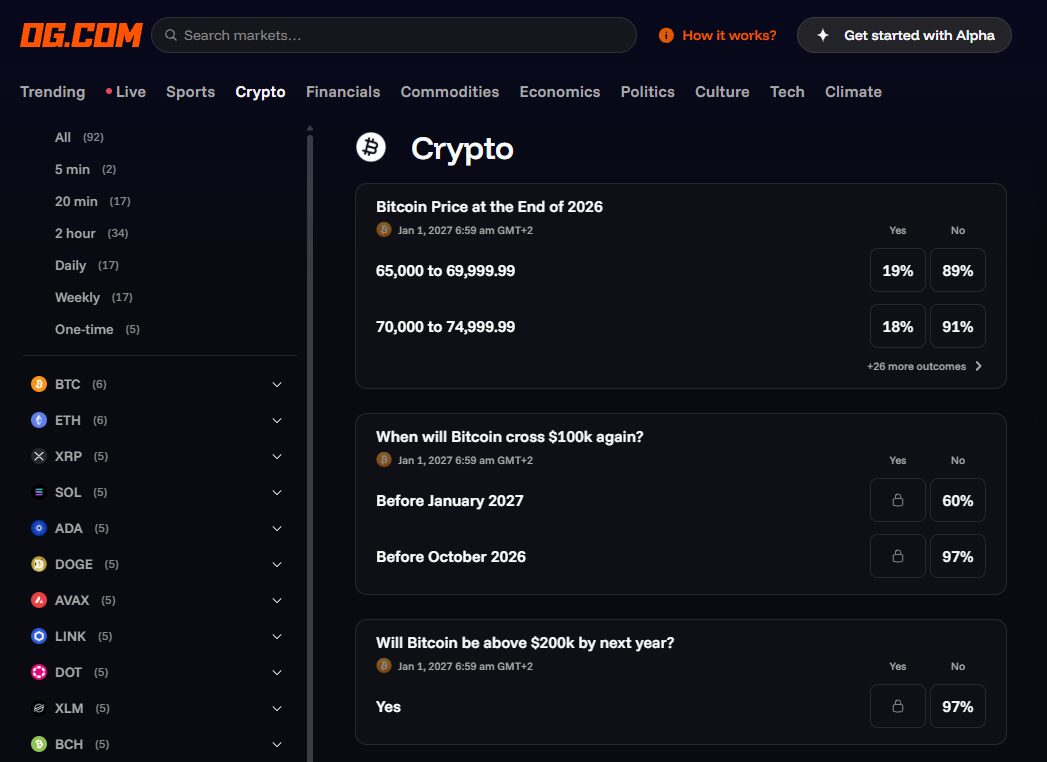
Trading is conducted through Crypto.com | Derivatives North America (CDNA), a CFTC-regulated designated contract market. Contracts are priced between $0.01 and $0.99 and settle at either $1.00 or $0.00 depending on the result.
Sports represent the platform’s largest market category, covering professional and college leagues, as well as formats such as parlays and player props.
Account funding starts from $1, with support for Plaid, debit cards, Apple Pay, Google Pay, PayPal, Venmo, and bank transfers. Only Plaid and wire/ACH deposits avoid processing fees.
New users can currently earn up to $100 in rewards after account verification and completion of a qualifying trade.
OG availability varies across the US. New York and Arizona residents cannot trade, while seven additional states — Illinois, Massachusetts, Maryland, Michigan, New Jersey, Nevada, and Ohio — allow access except for sports contracts.
The platform offers support through a help center, live chat, and native iOS and Android apps.
Pros:
- CFTC-regulated prediction market
- Extensive sports market coverage compared with similar platforms
Cons:
- No blockchain settlement or on-chain transparency
- Currently focused on the US
- No native token or crypto-based rewards system
Best for: US users seeking regulated event contracts.
3. Myriad Markets
Myriad Markets takes a DeFi-native approach, combining non-custodial trading, AMMs, and an order book system. Myriad operates through smart contracts instead of a centralized custodian. Users retain control of their funds, which remain in their wallets or are locked in smart contracts until markets settle.
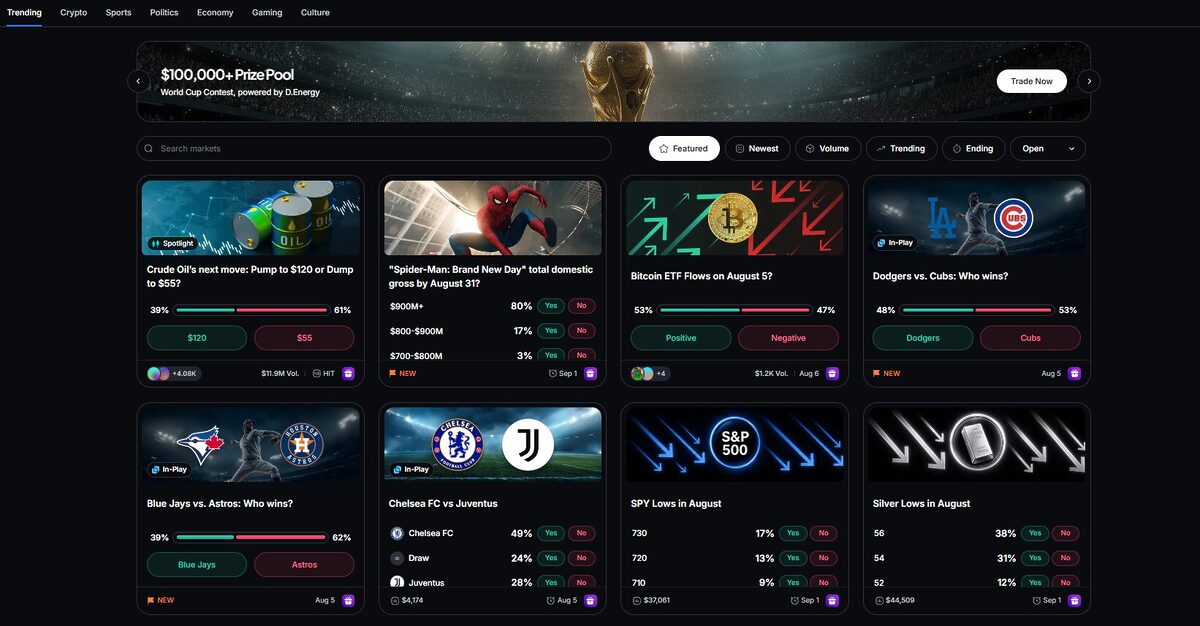
Built on EVM-compatible blockchain infrastructure, the platform combines automated market makers (AMM) with an order book system, giving traders access to decentralized finance (DeFi) tools. The platform may appeal to traders exploring prediction market arbitrage strategies.
Myriad supports funding through crypto deposits, the USD1 stablecoin on BNB Smart Chain, and fiat payment options including Apple Pay and MoonPay.
Trading fees range from 0% to 2% on buys, plus a small fixed gas fee of approximately $0.0085, with proceeds split between rewarding liquidity providers, protocol revenue, and revenue-sharing with third-party builders.
Myriad also runs a rewards program called MYR Points. Points are distributed based on trading activity, liquidity provision, open positions, and referrals, with additional incentives aimed at encouraging market liquidity and active trading.
Myriad uses blockchain-based infrastructure and requires a compatible wallet and some DeFi familiarity. The platform has direct in-app integration with Trust Wallet.
Pros:
- Non-custodial
- Direct in-app integration with Trust Wallet
Cons:
- Fees vary by market (0%–2% on buys)
- Requires a compatible wallet and some DeFi familiarity
Best for: DeFi users who prefer non-custodial platforms.
4. Opinion
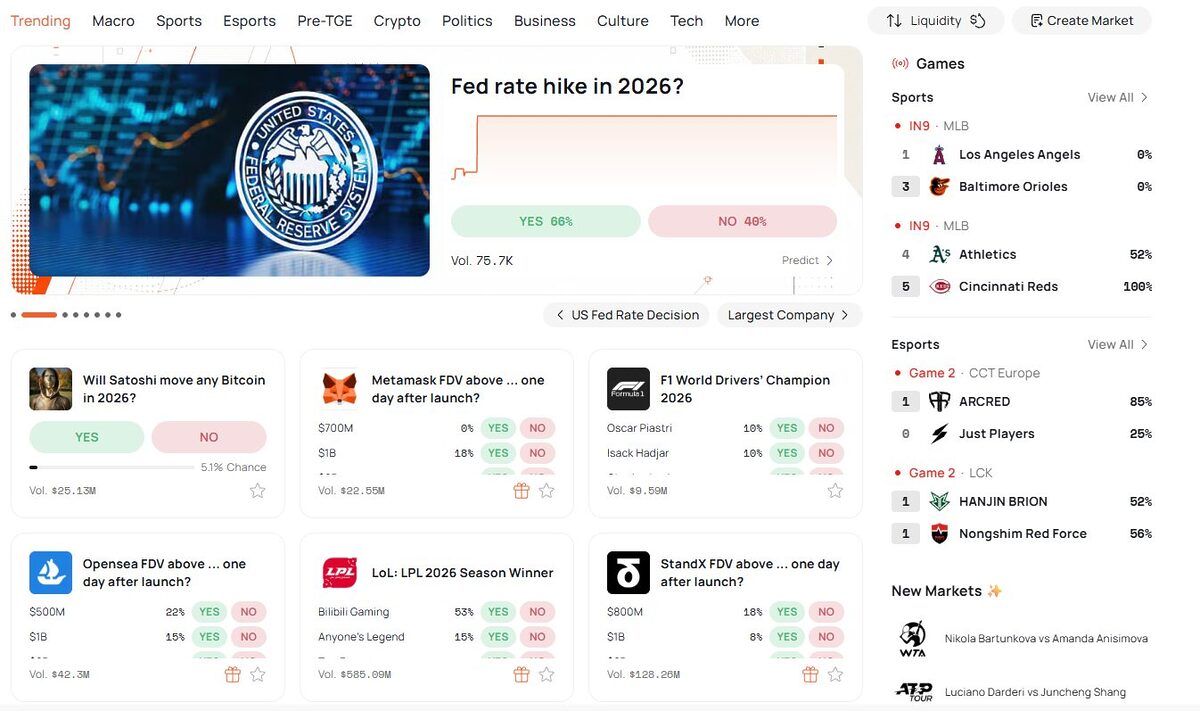
Opinion.trade is a new on-chain prediction market combining liquidity incentives with a native token ecosystem.
It allows users to trade Yes/No shares on real-world outcomes spanning macroeconomic indicators (Fed decisions, CPI), crypto-specific events, and social trends.
Opinion launched its BNB Chain mainnet in late 2025. It is backed mainly by YZi Labs, with additional investors including Animoca Ventures, Amber Group, Manifold, and Echo Community.
Opinion combines on-chain trading with Opinion AI as its main resolution oracle, while using third-party data sources like Chainlink for objective markets.
Fees apply only to market orders, ranging from 0% up to roughly 1%, peaking near 50% probability where outcome uncertainty is highest; makers providing liquidity pay no fee. A $5 minimum order and $0.25 minimum fee apply.
The platform rewards traders, liquidity providers, and holders through points-based incentives and referral programs.
The referral program offers up to 10% fee discounts for invitees, with referrer rewards based on referred activity; referral access unlocks after $1,000 trading volume.
Opinion reported more than $3.1 billion in cumulative trading volume by mid-November 2025. The platform became the third-largest prediction market by volume behind Polymarket and Kalshi and ranked among the largest on-chain prediction markets by TVL.
Opinion applies regional access restrictions. The platform’s native OPN token is trading across major crypto exchanges.
Pros:
- Rapid volume growth
- Zero-fee maker orders
- Native OPN token
Cons:
- Regional access restrictions apply
- Token price has been under selling pressure since launch
Best for: Crypto users interested in incentives and on-chain markets.
5. ADI PredictStreet
Launched in April 2026, ADI PredictStreet prediction market combines event contracts with regulated infrastructure and its own blockchain ecosystem.
The Yes/No event-contract platform is backed by Abu Dhabi’s ADI Foundation and operated by Predict Street Limited, licensed by the Government of Gibraltar.
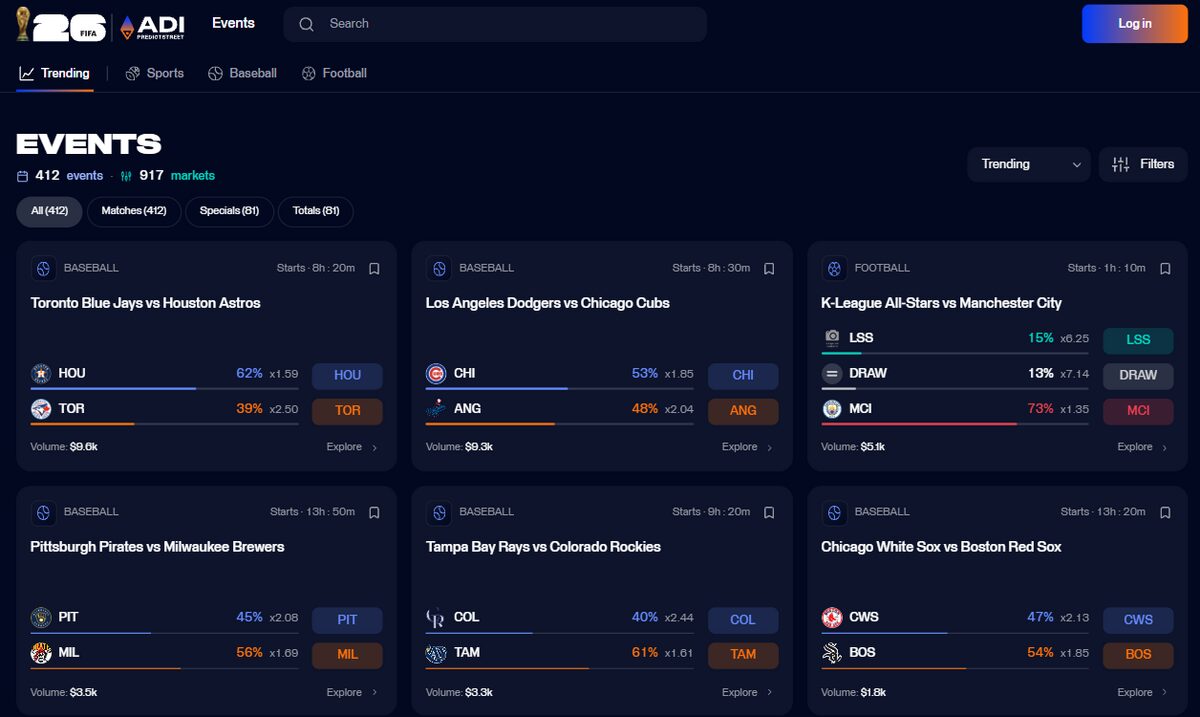
The platform is the official prediction market partner of the FIFA World Cup 2026. It enables users to forecast the outcomes of real-world events across sports, global news, technology, and cultural moments.
The platform runs on its own EVM-compatible ADI blockchain and operates exclusively in USD1 stablecoin pegged 1:1 to the US dollar.
ADI PredictStreet charges a small commission on each trade, taken as a percentage of the trading volume. The exact rate is displayed on each market page before you trade.
For US users, ADI PredictStreet routes trading through Fanatics Markets, which executes trades via Crypto.com infrastructure.
Deposits can be made by card, Apple Pay, wire transfer, or online banking, with card and Apple Pay deposits carrying a 2% fee and a $10 minimum.
ADI PredictStreet is accessible via any modern web browser on desktop and mobile. The platform does not currently offer a dedicated mobile app, but the company says an app may be introduced in the future.
Pros:
- Official FIFA World Cup 2026 prediction market partner
- Licensed in Gibraltar; US access routed through CFTC-regulated Fanatics Markets
Cons:
- No standalone US product
- No native mobile app
Best for: Users interested in sports and event-based markets.
The Bottom Line
The next generation of prediction markets is competing not only for users but also over market structure. From on-chain liquidity and token incentives to regulated trading infrastructure, each platform is testing a different approach to making real-world events tradable.
For users searching for Polymarket alternatives, Kalshi alternatives, or new crypto prediction markets, the market now offers a wider range of options depending on user priorities, including decentralization, trading functionality, regulatory oversight, and incentive programs.