

Payments company Stripe is reportedly in early discussions regarding a potential acquisition of PayPal Holdings Inc., according to a Bloomberg report. However, no formal offer has been made and both companies declined to comment.
Stripe is a privately held company valued at $159 billion and processes approximately $1.9 trillion in annual payment volume.
Sponsored
Its private status allows the company to pursue long-term strategic initiatives without the immediate pressures that come with public reporting requirements. In comparison, PayPal is a publicly traded company, subject to quarterly earnings reports and ongoing shareholder scrutiny.
Strategic Considerations
A merger between Stripe and PayPal would combine two of the largest payment providers globally. It would also bring together Stripe’s modern payment infrastructure with PayPal’s large consumer and merchant base.
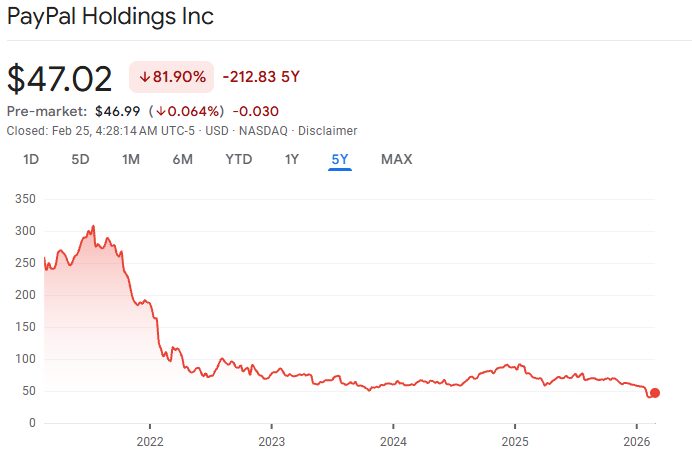
However, PayPal’s market capitalization has fallen dramatically from its 2021 highs, when it reached around $360 billion, to roughly $40 billion in early 2026, representing approximately 80 % decline over five years. Since the beginning of the year, PayPal’s stock price has declined by 19.46%.
According to the latest publicly available user statistics, PayPal has over 430 million active accounts worldwide, including both consumer users and merchants, with roughly 398 million consumer accounts.
If a deal goes through, it would signal major consolidation in the fintech sector, combining infrastructure, consumer reach, and digital asset capabilities.
Stripe would gain control over both payment infrastructure and branded wallet distribution, acquire Venmo, and expand its global merchant checkout capabilities, according to Arcady Lapiro, CEO of Agora Financial Technologies.
He added that the move could also accelerate AI-powered commerce and set the stage for stablecoin-enabled payment flows.
“This would be challenger-on-challenger consolidation at massive scale,” Lapiro noted. “If Stripe pulls the trigger, fintech officially enters THE Big League era!”
On the Flipside
- Integrating two large, complex technical platforms could present technical challenges, as Stripe relies on newer cloud-based systems, whereas PayPal has legacy infrastructure.
Why This Matters
A Stripe-PayPal deal could reshape the global payments landscape, shifting from innovation-focused disruption to a systemically critical part of financial infrastructure, with major regulatory and competitive consequences.
Explore DailyCoin’s hottest crypto news right now:
Binance Under Investigation Over Iran, Russia Sanctions, Ties to WLFI Scrutinized
Is SWIFT Putting XRP On? Lunch Behind Closed Doors
People Also Ask:
Stripe earns revenue by charging fees on payment transactions, subscription services, and enterprise solutions for businesses using its platform.
Fintech consolidation occurs when large financial technology companies merge or acquire competitors, potentially reshaping competition, infrastructure, and market reach.
Regulators monitor mergers to prevent excessive market concentration, protect consumers, and ensure financial stability.