

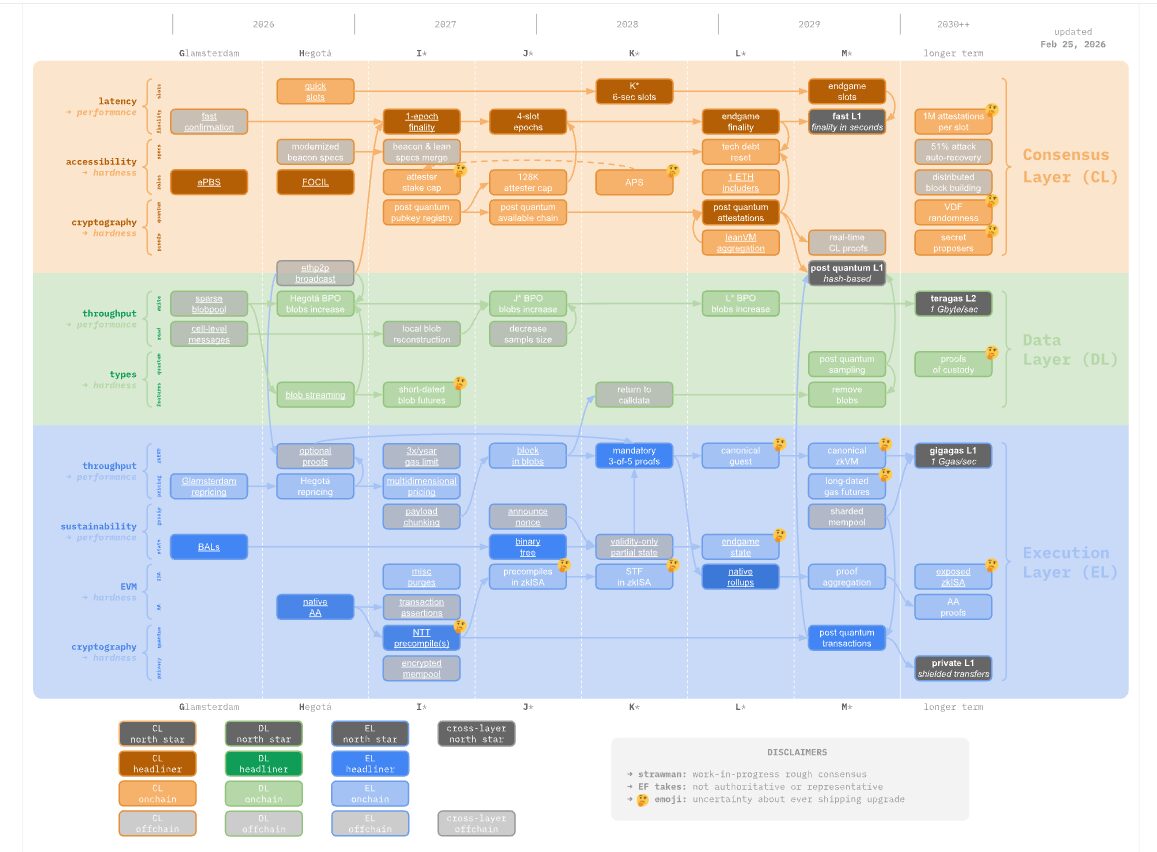
The Ethereum Foundation has released a technical outline known as the Strawmap, offering a long-term vision for the network’s Layer 1 protocol upgrades through 2029.
Designed as a discussion framework for developers, researchers, and governance participants, the document is not a fixed roadmap. The Strawmap provides insight into Ethereum’s priorities while leaving technical details and timing flexible.
Sponsored
Ethereum plans roughly seven major protocol upgrades over the next four years, with a pace of about one every six months. Each upgrade is expected to deliver incremental improvements across network speed, security, and privacy.
Speed, Scale, and Security in Focus
The Strawmap sets ambitious goals for Ethereum’s evolution. Developers are exploring ways to reduce transaction finality from minutes to seconds and to increase throughput at the base layer. Layer 2 networks are also expected to benefit from improved data availability, enabling greater scalability.
The roadmap also references research into post-quantum cryptography and potential privacy enhancements, which could strengthen Ethereum’s long-term security and privacy capabilities.
Performance improvements under discussion include shorter block times and reduced finality windows, though exact figures are still under study. These changes, if implemented, could significantly improve network efficiency and resilience.
Why This Matters
The Strawmap remains a draft, but it gives the first comprehensive view of where Ethereum’s developers are aiming to take the network. If the planned upgrades come together, they could make transactions faster, improve security, and make the network easier to scale, while also giving L2 applications more room to grow.
Discover DailyCoin’s hottest crypto scoops today:
NVIDIA Reports Record Q4 Revenue, Sends Crypto Higher
Breaking: Ethereum Foundation Starts Staking 70,000 ETH
People Also Ask:
The Strawmap is a draft technical framework outlining the Ethereum Foundation’s long-term vision for Layer 1 protocol upgrades. It’s meant to guide discussion and research, not serve as a fixed roadmap.
Key objectives include faster transaction finality, improved network throughput, enhanced Layer 2 scalability, post-quantum cryptography, and privacy features for ETH transfers.
Layer 2 solutions could benefit from improved data availability and scalability, allowing more transactions and decentralized applications to run efficiently on Ethereum.