

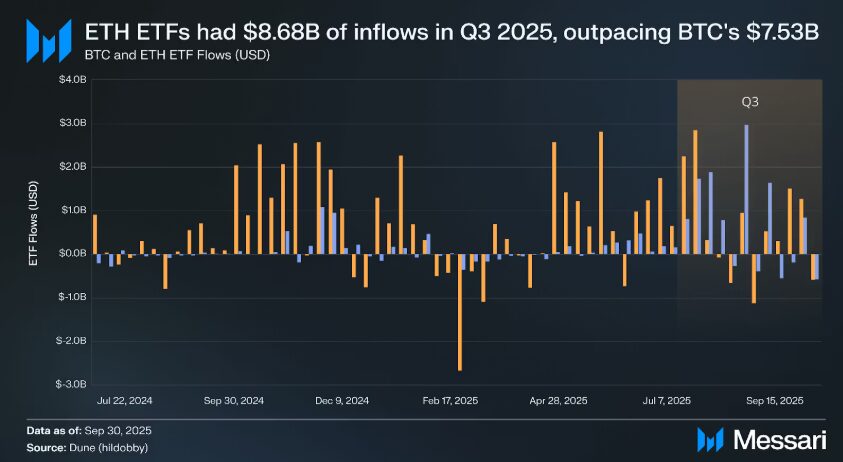
Ethereum exchange-traded funds (ETFs) attracted more inflows than Bitcoin ETFs in the third quarter of 2025, marking a major turning point in institutional crypto investing, according to Messari’s latest State of Crypto × TradFi Q3 2025 report.
Breakout Quarter for Ethereum
Messari data shows that Ethereum ETFs recorded $8.68 billion in inflows, surpassing Bitcoin’s $7.53 billion, marking the first time ETH products have outperformed BTC in this metric.
Sponsored
Total Ethereum ETF assets under management (AUM) jumped 170% quarter-over-quarter to $27.43 billion, representing 6.6 million ETH or 5.2% of the circulating supply. ETH’s price surged 77% in Q3, compared to Bitcoin’s 6.4% gain, partly fueled by demand from Digital Asset Treasury (DAT) companies.
BlackRock’s ETHA led the pack, growing 266% and capturing 58% of the Ethereum ETF market. Meanwhile, spot Bitcoin ETFs appeared to stabilize after their early 2024 boom, ending the quarter with $152.5 billion in AUM (+15% QoQ) and 1.36 million BTC held (6.9% of supply).
Staking ETFs Mark a Structural Shift
The rise of staking-enabled ETFs highlights a deeper structural shift in crypto investment products.
In May 2025, the SEC clarified that protocol-level staking does not constitute a securities offering, removing a major legal barrier for ETF issuers.
Shortly after, REX-Osprey launched the first U.S. Ethereum Staking ETF (ESK) in September, offering investors both ETH price exposure and on-chain staking rewards. The fund passes 100% of staking yield to investors, targeting institutional income seekers.
Major players including BlackRock, 21Shares, and Grayscale have since filed to add staking features to their Ethereum ETFs. The SEC’s decisions on these applications are expected between October and December 2025.
TradFi and Crypto Converge
Q3 also underscored the accelerating convergence between traditional finance and crypto. Banks, fintechs, and large enterprises are increasingly using blockchain for asset issuance, trading, and settlement.
Messari notes that this shift has moved beyond experimentation. Crypto is now integrating into regulated financial infrastructure.
Companies like JPMorgan, SWIFT, Stripe, and Google Cloud are developing tokenized settlement systems and enterprise blockchains, signaling that institutional adoption is moving from pilots to production.
Why This Matters
The growing synergy between ETFs, staking, and enterprise blockchain adoption signals that digital assets are evolving into mainstream financial instruments. Crypto markets are becoming more regulated, yield-generating, and intertwined with the traditional capital systems.
Discover DailyCoin’s hottest crypto news today:
Great Rotation Begins? $2.1T Gold Wipeout Powers $113K BTC
Bitcoin Flushes Out Leverage, Investors Start Quiet Accumulation
People Also Ask:
An Ethereum ETF (Exchange-Traded Fund) is a regulated investment vehicle that tracks the price of Ether (ETH), allowing investors to gain exposure to Ethereum without directly holding the cryptocurrency.
A spot Ethereum ETF directly holds ETH as its underlying asset, while a futures ETF uses derivatives contracts to track ETH’s price. Spot ETFs are generally considered more transparent and aligned with actual market demand.
Ethereum ETFs hold ETH or ETH futures and issue shares that trade on traditional stock exchanges. The ETF’s share price mirrors Ethereum’s market value, giving investors price exposure through a brokerage account.
Ethereum ETFs make crypto exposure easier for institutional and retail investors by offering regulated, liquid, and tax-efficient access to ETH. They also help integrate crypto into mainstream financial markets.