

Losses from cryptocurrency ATM fraud surged to $333.5 million in 2025, according to a new report from blockchain security firm CertiK.
Criminal syndicates are exploiting a technical flaw known as the “attribution gap,” which decouples physical cash deposits from blockchain transactions and complicates efforts by investigators to trace illicit flows.
The Frictionless Extraction Channel
Crypto ATM scams are rising alongside the rapid expansion of kiosk networks.
Sponsored
Data cited by the report shows that the Federal Bureau of Investigation (FBI) recorded more than 12,000 complaints through November 2025, a 33% increase from the prior year.
The United States hosts roughly 78% of the world’s 45,000 crypto ATMs. These kiosks allow users to convert cash into cryptocurrency in under five minutes, often with minimal identity verification.
The speed and irreversibility of blockchain transfers make crypto ATMs the lowest-friction extraction channel available to organized crime, the report says.
‘Attribution Gap’ Limits Law Enforcement Tracing
CertiK identifies a critical forensic blind spot in how these machines operate.
Crypto ATMs function as front-end terminals for a centralized Crypto Application Server (CAS). When a victim deposits cash, the operator releases cryptocurrency from a commingled hot wallet.
The blockchain records only the transfer from the operator to the scammer’s wallet, not the victim’s identity.
CertiK describes this as an “Attribution Gap.” Investigators must subpoena operator CAS logs to connect a physical cash deposit to a blockchain transaction.
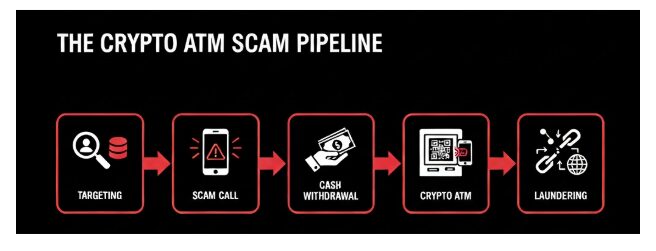
Crypto ATM Scam Pipeline
According to the report, criminal networks often begin attacks using data from large-scale breaches, purchasing curated lists that identify vulnerable individuals by age or financial history.
Scammers then launch automated text and voice campaigns designed to trigger panic, frequently using threats of arrest or fabricated family emergencies.
Once contact is established, attackers maintain a live phone connection with victims to isolate them from relatives or bank staff. This “stay-on-the-line” protocol allows scammers to coach victims through cash withdrawals and kiosk deposits while bypassing fraud warnings.
Older Adults Bear the Largest Losses
The report finds that older Americans account for 86% of crypto ATM fraud losses.
A lawsuit filed by the Office of the Attorney General for the District of Columbia against operator Athena Bitcoin alleged that 93% of deposits at its District kiosks were linked to fraud, with a median victim age of 71.
Investigators said on-screen warnings proved ineffective when scammers simultaneously coached victims during live phone calls.
AI and the 2026 Threat Outlook
CertiK says transnational criminal groups are scaling ATM-based fraud operations using specialized teams focused on lead generation, social engineering, and laundering.
Asian money-laundering networks processed an estimated $16.1 billion in illicit crypto flows in 2025, clearing transactions within minutes through Telegram-based services in Southeast Asia.
The report also warns that AI-driven scams are becoming more profitable, generating 4.5 times higher returns than traditional schemes. Attackers increasingly deploy deepfake voice and video technology to impersonate trusted relatives or officials.
Meanwhile, the policy landscape remains fragmented, the report says. Indiana became the first U.S. state to ban crypto ATMs this month. Most jurisdictions instead rely on transaction caps, while federal proposals like the Crypto ATM Fraud Prevention Act remain stalled in the Senate.
CAS Monitoring as the Key Defense
CertiK argues that the only effective technical intervention is real-time wallet screening at the CAS level. By flagging destination addresses against known blocklists before a transaction is broadcast, operators could disrupt the fraud pipeline at the point of ingress.
Without stronger federal oversight, CertiK warns that criminal networks will continue treating the U.S. crypto ATM network as an industrial-scale “cash-out” infrastructure.
Dig into DailyCoin’s trending crypto scoops today:
HBAR Targets Central Bank Rails & AI Agents As Q2 2026 Catalysts
Bonk.Fun Tells Users To Stay Away: Site Hijack Drains Wallets
People Also Ask:
Crypto ATM fraud occurs when scammers trick individuals into depositing cash at cryptocurrency kiosks, which is then converted to crypto and stolen.
Criminals use phone or online coaching, data from breaches, and the “attribution gap,” which decouples cash deposits from on-chain transactions.
Operators can implement real-time wallet screening at the CAS level, and regulators can enforce standardized oversight, transaction limits, and cooling-off periods.