

- Circle shares fell more than 18% in early trading following the announcement of Open USD.
- The initiative is backed by more than 140 firms, including Stripe, Visa, Mastercard, Coinbase and BlackRock.
- Additional pressure came from index removals and recent insider selling.
Circle Internet Group (CRCL) shares fell more than 18% in early trading Monday after a consortium of more than 140 financial and technology firms, including Stripe, Visa, Mastercard, Coinbase, and BlackRock, announced plans for a new dollar-backed stablecoin called Open USD.
Sponsored
The decline came as investors weighed potential competitive pressure on Circle’s USDC business, alongside recent index removals and insider selling.
New Stablecoin Consortium Enters Market
Open Standard, an independent organization backed by more than 140 firms across payments, banking, fintech and crypto, announced the Open USD initiative on June 30, 2026.
Zach Abrams, co-founder of Stripe-owned stablecoin infrastructure firm Bridge, is serving as founding chief executive of the consortium, according to people familiar with the matter.
The initiative includes founding participants such as Stripe, Coinbase, Visa, Mastercard, BlackRock, Alphabet, BNY Mellon, Standard Chartered, DBS, U.S. Bank, Shopify, IBM, Fireblocks, Anchorage Digital, MetaMask, Aave, Solana, Polygon and Ripple.
Different Economic Model for Stablecoins
Open USD introduces a structure that differs from issuer-led stablecoins such as USDC.
Under the proposed model, approved institutions would be able to mint and redeem tokens without fees or volume limits. Interest generated from Treasury reserves backing the token would be distributed among participating partners, after management fees, rather than retained by a single issuer.
Governance of the system would be overseen by a board composed of consortium members, rather than a centralized corporate structure.
“Existing stablecoins have great strengths, but to use them at scale, businesses need something that’s open, low-cost, high-throughput, broadly accessible, and aligned to their interests,” Zach Abrams noted.
Coinbase’s participation drew particular attention given its historical role in co-founding USDC alongside Circle through the Centre Consortium. That relationship has included revenue-sharing arrangements expected to be renewed in 2026.
Circle Faces Additional Headwinds
Circle faced additional pressure in June, with its share price falling more than 40% over the course of the month, sliding from $104.97 at the start of June to $62.63 by July 1.
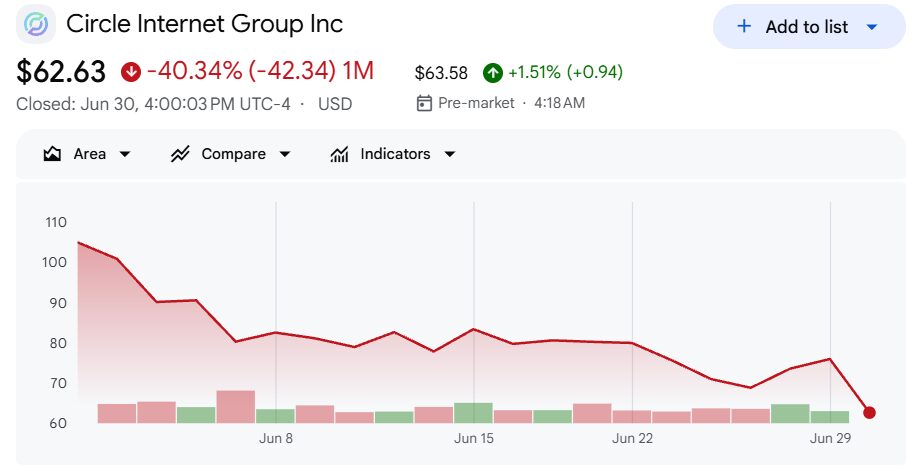
The stock was also weighed down by company-specific developments, including its removal from several FTSE Russell growth indexes during the latest annual reconstitution. The changes affected its inclusion in key benchmarks such as the Russell 1000 Growth and Russell 3000 Growth indices.
Separately, regulatory filings showed that Circle insiders sold approximately $158.7 million in shares over the past three months, with no offsetting insider purchases.
Analysts Divided on Competitive Impact
Some analysts said the market reaction may reflect broader concerns about increased competition in the stablecoin sector, though they cautioned that early-stage consortium projects often take time to scale.
Clear Street analyst Owen Lau noted that similar yield-sharing stablecoin models have so far seen limited adoption. Paxos’ USDG, launched in 2024, has grown to roughly $3 billion in circulation, compared with USDC’s estimated $73–74 billion supply.
Market Context
The stablecoin market, currently valued at above $306 billion, is projected to expand toward $4 trillion by 2030. As institutional adoption accelerates, competition is shifting from token issuance to control over payment rails and settlement infrastructure.
However, competition in the sector has increasingly shifted from token issuance toward control of payment infrastructure, settlement rails and distribution networks.
Circle remains one of the largest regulated stablecoin issuers, but faces a more competitive landscape as traditional financial institutions and fintech firms explore tokenized dollar products.
Why This Matters
Circle (CRCL) shares fell even as the S&P 500, Dow, and Nasdaq all closed higher, indicating the move was driven by company-specific factors rather than broader markets.
The decline comes amid increased competitive pressure in the stablecoin sector following the entry of a large, well-funded consortium into the market.
Dive into DailyCoin’s popular crypto news right now:
Taiwan Passes First Crypto Licensing Law, Ending AML-Only Regime
TradFi Perps Hit $1.3T as Crypto Traders Abandon Spot Markets
People Also Ask:
Open USD is a new dollar-backed stablecoin launched by Open Standard, a consortium of over 140 companies including Stripe, Visa, and Coinbase.
Open USD shares reserve yield with partner businesses and charges no minting or redemption fees, unlike Circle’s model.
Open Standard has said Open USD is expected to go live later in 2026.