

Institutional exposure to Bitcoin fell sharply in Q1 2026, marking the first significant stress test for the US spot Bitcoin ETF era, according to a new CoinShares 13F analysis.
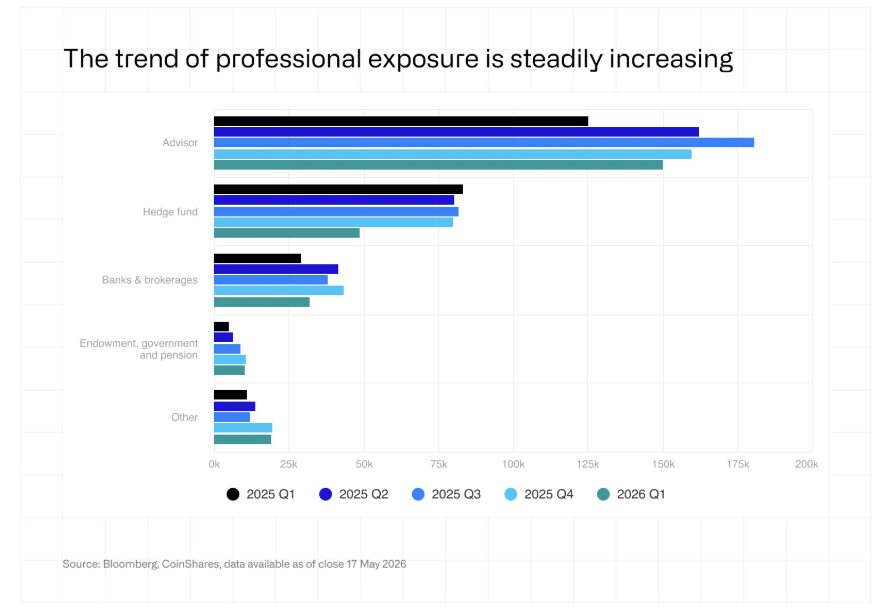
Professional Bitcoin holdings recorded their steepest quarterly decline since US spot Bitcoin ETFs launched, dropping from 313,000 to 261,000 BTC — a 17% quarter-on-quarter fall.
Sponsored
The total dollar value of institutional Bitcoin exposure collapsed 35% to $17.8 billion, as BTC fell roughly 22% during the quarter.
While overall holdings declined, the data points to a clear split in institutional behavior: tactical funds exited positions aggressively, while long-term allocators and financial advisors largely held or accumulated.
The Concentrated Institutional Bitcoin Selloff
The most important structural insight from the data is the concentration of outflows.
According to the CoinShares report, almost all of the reduction in Bitcoin ETF exposure came from two segments: hedge funds and brokerages.
Hedge funds cut their holdings by 39%, while brokerages fell even further, shedding 53% of their Bitcoin exposure. Together, these two groups accounted for 95% of the total reduction in institutional exposure.
Two names dominated the brokerage exit. Morgan Stanley fully liquidated its 8,300 BTC position, a move CoinShares links to the April launch of its own spot Bitcoin ETF, MSBT.
Meanwhile, Jane Street reduced its exposure by 10,800 BTC, consistent with hedging activity expected from a major ETF market maker during a quarter characterized by significant outflows.
Financial Advisors Remain Core Bitcoin ETF Holders
In contrast to hedge funds, financial advisors, the largest professional cohort by far, holding 150,300 BTC or 58% of all 13F Bitcoin holdings, showed relative resilience during the downturn.
Advisor-held Bitcoin exposure declined only modestly, around 6% quarter-over-quarter, making them the dominant structural holder base within institutional ETF allocations.
Banks Increase Bitcoin Exposure
While hedge funds and brokerages retreated, banks more than doubled their aggregate Bitcoin holdings to 15,200 BTC, a 339% year-on-year increase.
JPMorgan added approximately 3,000 BTC, Wells Fargo added 4,000 BTC, Italy’s Intesa Sanpaolo entered with 1,600 BTC, and Citigroup disclosed a position for the first time at 97 BTC. This now places every major US banking franchise on record as a Bitcoin holder via ETF disclosures.
Sovereign-linked entities continued incremental accumulation. Governments added 1,100 BTC in Q1, entirely from Abu Dhabi’s Mubadala Investment Fund, bringing the sovereign cohort to 8,300 BTC in total.
Although still small in absolute terms, the government segment has recorded consistent growth across consecutive quarters.
Bitcoin ETF Ownership Structure Shifts
The report also points to subtle shifts in ETF ownership composition. The share of Bitcoin ETF assets held by institutions included in the report declined from 24.7% to 20.8%, suggesting faster growth among non-included participants, like retail and other non-reporting segments.
Rather than signaling structural weakness, analysts interpret this as a normalization phase in ETF market composition, where ownership becomes more diversified over time.
Bitcoin Institutional Selloff Reveals a Dual-Speed Market
CoinShares frames the quarter as a transition phase in institutional Bitcoin adoption: tactical capital, including hedge funds and brokerages, is exiting during volatility, while structural capital, including advisors, banks, and sovereign-linked investors, is holding or accumulating.
The result is a dual-speed market where Bitcoin exposure is increasingly determined by investment horizon rather than unified institutional sentiment.
Check out DailyCoin’s hottest crypto news right now:
Bitcoin Slips While Stocks Hit Records. Is a Liquidity Rotation Underway?
Bitcoin Slides Below $70K: Did Mt. Gox Play a Role?
People Also Ask:
A Bitcoin institutional selloff refers to a period when large financial entities such as hedge funds, brokerages, or asset managers reduce their exposure to Bitcoin, often through ETFs or direct holdings. These moves are typically driven by risk management, portfolio rebalancing, or changes in market conditions.
Institutions may sell Bitcoin due to increased market volatility, macroeconomic uncertainty, profit-taking, or shifts in risk appetite. In some cases, selling is also linked to hedging activity or internal portfolio adjustments rather than long-term bearish sentiment.
During institutional selloffs, long-term investors such as financial advisors, private banks, sovereign-linked funds, and retail investors often continue accumulating, partially offsetting selling pressure.