
The decentralized AI tokens sector is experiencing a surge following a major regulatory crackdown in the traditional AI space.
The US Department of Commerce issued an emergency export control directive on Friday, ordering Anthropic to suspend all access to its newly launched flagship models, Fable 5 and Mythos 5.
Sponsored
Citing vague national security concerns, the directive bans any foreign national, both inside and outside the United States, including Anthropic’s own foreign employees, from accessing the frontier cybersecurity-focused models.
As isolating users by nationality is virtually impossible under the current architecture, Anthropic disabled both models for all customers globally.
Centralized AI Faces Its “Single Point of Failure” Moment
According to an official statement from Anthropic, US authorities acted under national security provisions after identifying a potential jailbreak method affecting Fable 5. No detailed public evidence was provided.
Anthropic’s internal review of the government’s demonstration concluded that the issue involved a narrow set of previously known vulnerabilities rather than a novel exploit.
The company noted that similar weaknesses are commonly found across advanced AI systems in the industry.
Anthropic Disputes Scope of the Action
Anthropic stated it is complying with the order while disagreeing with its scope.
The company had spent thousands of hours red-teaming Fable 5 with the US government, UK AI Safety Institute (AISI), and third-party organizations prior to launch, and argues that applying this recall standard across the industry “would essentially halt all new frontier model deployments.”
“Permissionless AI” Narrative Takes Hold
The move quickly spilled over into digital asset markets, where proponents of decentralized AI framed the decision as validation of censorship-resistant and permissionless infrastructure models.
According to data from CoinGecko, AI-related tokens rose roughly 10% over the past 10 days, with a 4.1% gain over the last 24 hours.
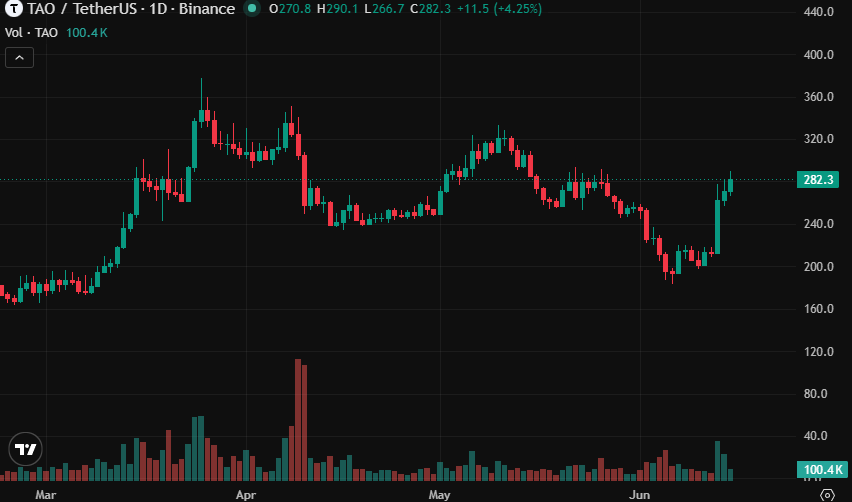
In decentralized AI infrastructure, Bittensor (TAO), widely regarded as the most significant decentralized AI network today, saw a nearly 39% price spike since the day Anthropic suspended its new flagship models, extending its momentum as a leading protocol in the “core AI networks” segment.
TAO briefly touched $289.7 on Monday before declining to the $279.5 level at the time of writing. This marks the largest price move in days since mid-March.
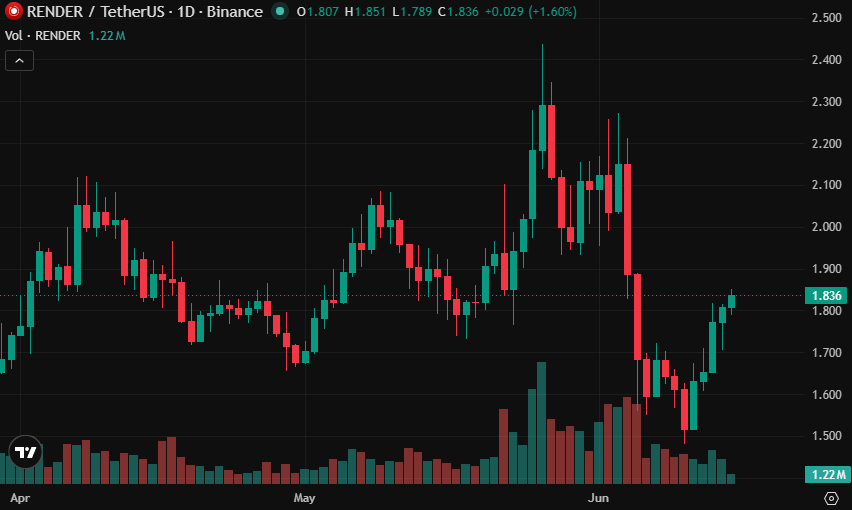
The infrastructure layer supporting decentralized AI scaling is also reaping the rewards.
Render Network (RENDER, former RNDR), which provides decentralized GPU computing power necessary for training and running models without centralized cloud providers, posted over 15% gain since Friday, including a 3.5% rise in the past 24 hours.
Why This Matters
The move highlights how quickly centralized AI systems can be restricted or disabled through regulatory action. It also reinforces the investment case for decentralized AI networks and AI coins, which are increasingly viewed as alternatives.
Stay in the loop with DailyCoin’s top crypto scoops:
Bitcoin Nears $66K on Peace Optimism and Mining Difficulty Decline
Cardano’s Treasury Panic Misses The Point: “DOT-Style” Pitfall Next?
People Also Ask:
AI tokens are crypto assets used in decentralized AI networks to pay for computing power, reward contributors, and govern protocol operations. They function as the economic layer for AI systems built on blockchain infrastructure.
Decentralized AI refers to AI systems that distribute computation, data processing, and model execution across independent nodes rather than relying on a single centralized company or cloud provider.
Traditional AI platforms rely on centralized infrastructure and controlled access to models. Decentralized AI distributes workloads across global participants and uses tokens to coordinate incentives and access.