

Bitcoin broke back above $80,000 and the market has started to recover. Launch calendars filled up within weeks. More tokens are going live every day now than at any point since the correction began.
The problems have not changed at all. In June 2026, at the bottom of the cycle, the graduation rate on the largest memecoin launchpad was 0.26%. Roughly one token in four hundred reached a real market. An estimated 97% of tokens launched since early 2024 are dead or barely trading. A recovering market brings more launches, and so far it is bringing the same failures at a larger scale.
Sponsored
People who work on launches for a living keep seeing the same small set of mistakes, made in the same order, by teams that had every chance to avoid them. Most happen months before the token goes live. Here are the eight that come up most often.
1. Allocating >50% of budget on Launch.
Ask founders where their launch budget went and the answer is usually the same: most of it went into getting listed.
That is the expensive misconception. The listing itself is a one-time cost. What follows it is not. Exchanges monitor order book depth, spreads and quote uptime continuously after a token goes live, and those obligations cost money every month. Projects that spend everything on the listing fee find themselves unable to fund the market quality requirements that come with it, and exchanges have been quicker to delist tokens that slip below their thresholds.
Advisors now give one practical rule here. Map your costs for at least six months past the listing date. A budget that runs out in week two produces problems by month two, and by then the options are all bad ones.
2. Booking the market maker after the listing date is public
Market making desks keep seeing the same pattern. A project shows up two weeks before a listing date that has already been announced and asks for a full setup.
Proper onboarding takes four to six weeks. The desk needs to understand the tokenomics, set up infrastructure on every venue the token will trade on, and build a launch day plan with the team. Compressing that into a fortnight means launching with a book that was configured in a hurry, and hurried books show it on day one.
Top Market Making firms in this space like Wintermute, GSR, EchoTrade and Keyrock, and their onboarding timelines are broadly similar because the work is similar. What that work actually looks like day to day is covered in this guide to crypto market making. The short version is unglamorous: resting orders on both sides of the book, all day, so the token stays tradeable.
There is a second cost to booking late. A desk that joins early helps choose the venues. Market makers work across dozens of exchanges and know which ones fit which token profiles. That advice is free if you ask before the announcement. It is useless after.
3. Signing a token loan deal without reading the option terms
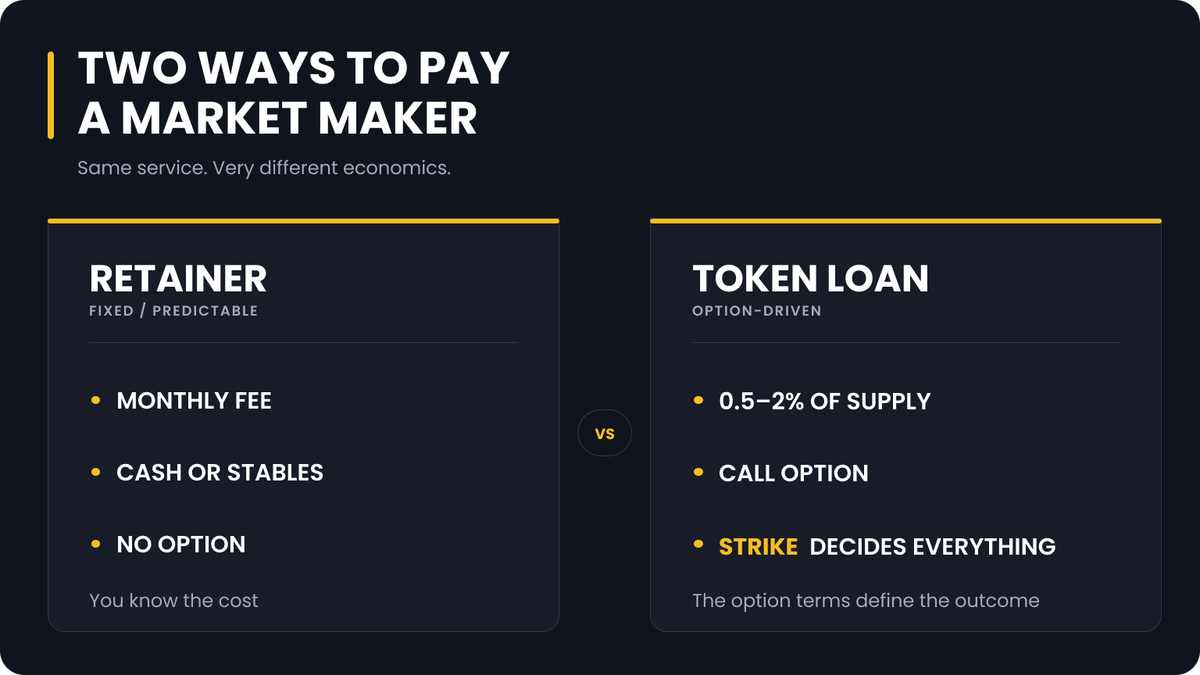
Market makers get paid in one of two ways. Either a monthly retainer, paid in cash or stablecoins. Or a token loan, where the desk borrows 0.5 to 2% of supply and holds a call option to buy those tokens later at a preset price.
Neither model is a scam. But they create very different incentives, and founders regularly sign the second one without understanding what the option does. The option pays out above the strike price. That ties part of the desk’s compensation to where the price goes rather than to how orderly the book is.
Three terms decide whether a loan deal is fair. The strike price and who sets it. The term length. And what happens to the borrowed inventory if the deal ends early. The full comparison of retainer versus token loan structures goes through each one.
The market has been drifting in a clear direction on this. Projects with cash increasingly pick retainers because the incentives are cleaner. Token loans remain the realistic option for teams that have tokens and no treasury, and plenty of desks run them honestly. The launches that die here are the ones where the founders learned what a strike price was after signing.
4. Listing on more exchanges than the budget can support
Five listings looks better than two in the announcement thread. But if the budget only funds real liquidity on two venues, the other three get thin books and wide spreads, and eventually a warning email from the exchange’s market quality team.
Every serious venue measures the same things: resting depth within a set percentage of the mid price, spread, and quote uptime. A neglected book gets noticed by compliance long before it gets noticed by traders.
What founders skip is the arithmetic. Market making costs scale with venue count. Retainers in this industry generally run from several thousand to tens of thousands of dollars a month depending on scope, and every extra venue adds infrastructure and inventory on top. The exchange count question is really a budget question wearing a different hat.
The advice that has quietly become standard: start on mid-tier venues, build a track record, move up when the liquidity supports it. The 2021 race to list everywhere at once is over, and the projects still running it are funding order books nobody trades on.
5. Expecting the volume generation on your token.
Exchanges care about volume. They earn fees on every trade, volume decides which tokens keep their listings, and no amount of industry commentary changes that arithmetic. Where founders go wrong is in who they think produces it.
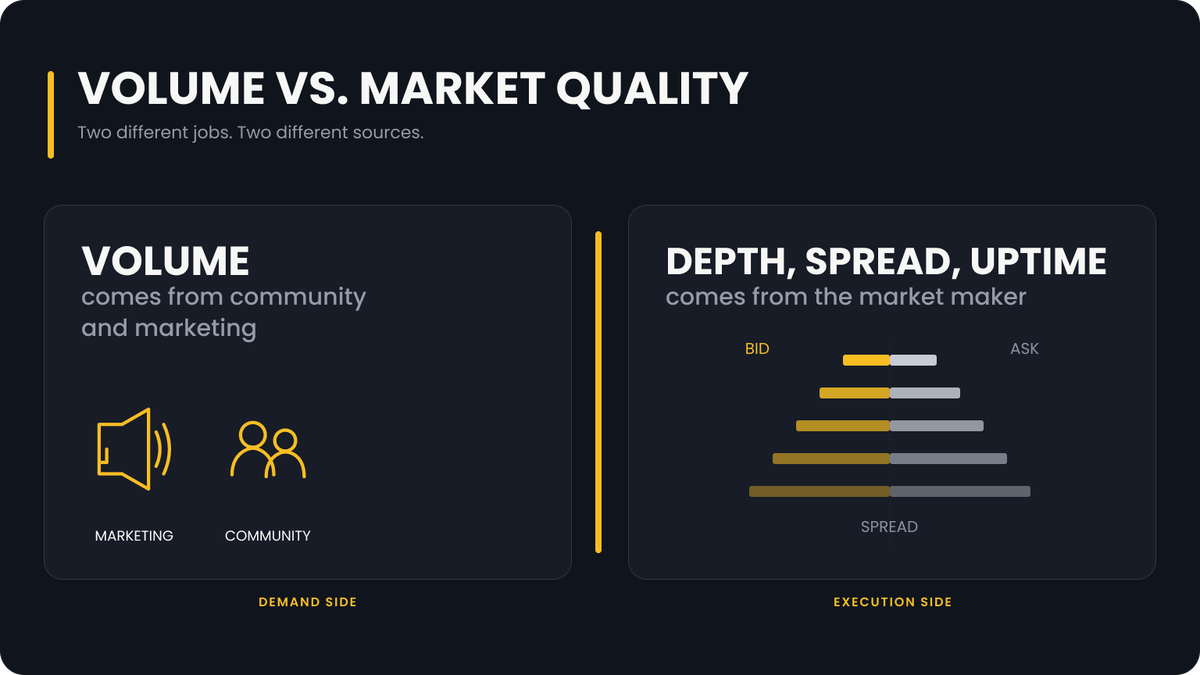
Volume comes from people who want to trade the token. Which means it comes from an engaged community, from marketing, from a reason to hold and a reason to trade, from a product itself. A market maker cannot manufacture that, and a desk that offers to should be read as a warning sign. The 2024 SEC wash trading cases put the mechanics of manufactured volume into public court records, and exchanges responded by screening for exactly those patterns during listing review. A token arriving with a suspicious volume profile now faces harder questions rather than easier ones.
What the market maker actually owns is the other half of the equation: depth, spread and uptime. Real resting orders that let the volume happen without the price gapping. The clean way to think about it is that marketing creates the desire to trade, and market making makes the trade executable. Projects that ask a desk to solve a demand problem end up with neither, and usually with a compliance letter as well.
6. Unlocking team tokens into the launch (Tokenomics)
Traders read vesting schedules. All of them. If the schedule shows insiders can sell on day one, the market prices that in immediately and the token opens under sell pressure that no marketing budget can offset.
The standard in 2026 is well established. Team tokens carry a cliff of six to twelve months, then vest over two to four years. Investor allocations follow comparable schedules, proportional to their entry price. Three things make experienced participants close the tab: team allocation above roughly 25%, short cliffs, and VC entry prices sitting far below the public price.
The vesting schedule is public information. It is often the first document a serious buyer opens. It should tell a story about long term intent, because whatever story it tells, the market will believe it.
7. Starting marketing the week of the launch
Demand has to exist before the token does. That sentence sounds obvious and gets ignored constantly.
Teams that start community building, content and outreach six to eight weeks ahead arrive at listing day with buyers who already know what the token is. Teams that start with the listing announcement are introducing themselves at the exact moment they most need to already be known, and they are competing against projects that spent two months building anticipation.
The failure is visible in the chart within hours. Attention hitting a token with no preparation behind it produces the signature pattern of 2026’s failed launches: a vertical spike, no resting orders underneath, and a book that never recovers. A marketing success and a liquidity failure, occurring simultaneously, each making the other worse.
8. Winging the day itself
The last mistake is the strangest one, because it happens after everything else went right. Teams spend months preparing a launch and then treat the day itself as something that will simply happen.
A token generation event has a sequence. The token contract, the distribution, the pools going live, the exchange listing, each announcement triggering a wave of trading activity the order book has to be ready for. The desk needs the exact listing time on every venue. The marketing posts need to be scheduled around those times, not improvised. Someone needs to own the plan for what happens if something breaks, because at some point something does.
What actually happens hour by hour on the day is laid out in this walkthrough of a token generation event. Teams that read something like it in advance spend launch day executing. Teams that do not spend launch day reacting, in public, with money on the line.
The launch is when you lose control
There is a thread running through all eight mistakes, and it is worth stating plainly, especially in a recovering market where the temptation to rush has returned.
A token launch is the moment a project hands the market a tool of influence over it. Before the launch, the team controls the story. After it, the price does. Every gap in the structure that existed quietly before the launch gets priced loudly after it. Thin demand shows up in the book. A missing audit shows up in the questions. An untested product shows up in the sell orders of the people who tried it.
So the teams that survive the 0.26% filter are the ones that arrive prepared on every front at once. Real demand, built weeks ahead. A product that works. An audit completed and public. Tests done before the community runs its own. The structure has to exist before the token does, because launching is not the start of building it. Launching is the deadline.
A rising market does not change any of this. It just raises the cost of learning it late.